

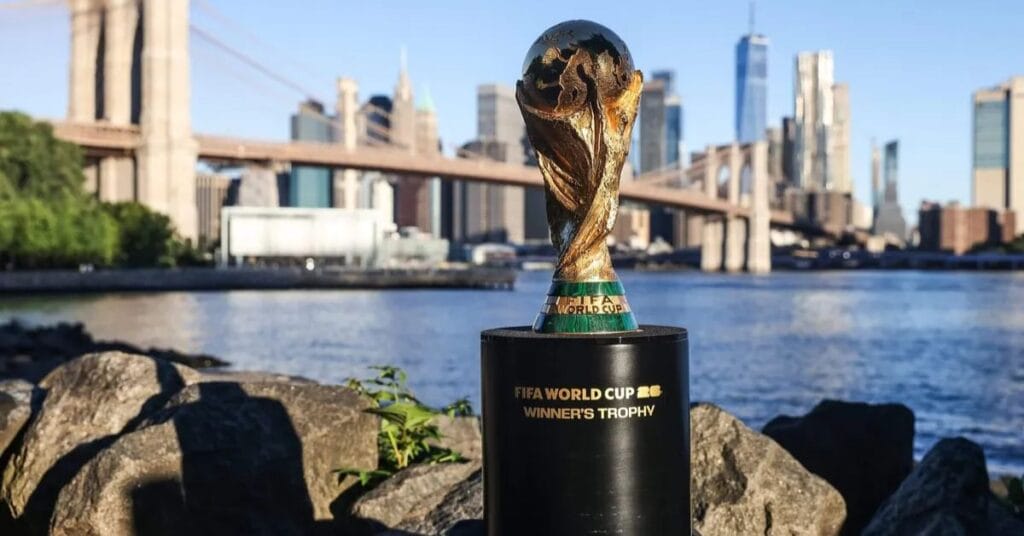
On June 11, 2026, the biggest sporting event on the planet kicks off in North America. The FIFA World Cup returns to the United States for the first time since 1994, across 11 American cities, with 78 matches, and a global audience that is expected to be the largest for any event in television history.
That is 87 days from today.
For European brands that have been watching the US market from a distance, wondering when the right moment might be to make a move, that number is the answer. Not next year. Not after the tournament. Now.
This is not about football. It is about what happens when the world’s attention lands on one country for 39 days, and whether your business is there when it does.
Why the 2026 World Cup Is the Biggest Commercial Moment in a Generation
Before we talk about what European companies should do, let us be clear about the scale of what is coming. These are not projections dressed up to sound impressive. These are verified numbers from credible sources, and they paint a picture that every serious international brand needs to understand.
Reason 1: 5 billion people will follow this tournament
The 2022 World Cup final between Argentina and France drew 1.5 billion viewers worldwide. Across the entire tournament, around 5 billion people tuned in at some point, according to FIFA. That already made it the most-watched sporting event on earth. For 2026, FIFA is projecting around 6 billion people will engage with the tournament in some form, which would make it the most-watched event in human history. To put that in context, the Super Bowl draws roughly 120 to 130 million viewers in a single night. The World Cup final alone is projected to be watched by over 1.6 billion people live.
Reason 2: 87 million Americans are interested in this tournament
Soccer’s growth in the United States is real and accelerating. Research covering multiple data sources estimates that approximately 87 million Americans express at least some interest in the World Cup. The 2022 World Cup Argentina vs France final drew 25.8 million US viewers across English and Spanish broadcasts, a 31% jump from 2018, despite the event being held in Qatar at inconvenient hours.
In 2026, matches are in primetime, in American cities, with the US team playing on home soil. Fox Sports is broadcasting 340 hours of live first-run programming, with a record 70 matches on network television, more than double the coverage of 2022. This is a domestic audience of unprecedented scale for any summer sporting event.
Reason 3: 6.5 million tickets across 104 matches, all sold out
FIFA is distributing 6.5 million total tickets across 104 matches in the 16 host cities. Demand has been extraordinary. Over 150 million ticket requests were submitted in the first 15 days of sales alone, making the tournament 30 times oversubscribed. FIFA president Gianni Infantino confirmed every match is sold out. Every stadium, across all 11 US host cities, will be full for every match.
Reason 4: 1.2 million international visitors are coming to the US specifically for the World Cup
Tourism Economics projects 1.2 million international visitors will travel to the United States for the tournament, 742,000 of whom represent new trips that would not otherwise have happened. These visitors stay an average of 12 days and spend approximately $416 per day. They are not just coming to watch football.
They are coming to experience American cities, American businesses, American culture, and American commerce. For European brands with US presence, this is your audience arriving at the door.
Reason 5: The US economy receives a $17.2 billion GDP boost
The United States alone is expected to receive a $17.2 billion GDP boost from the tournament, according to FIFA projections. Oxford Economics projects hotel revenues will rise between 7% and 25% in host cities around match days, with later rounds generating even sharper spikes. The Dallas area alone expects $1.5 to $2.1 billion in economic impact.
Seattle projects $929 million. Kansas City projects $653 million. This is not evenly distributed background noise. It is a concentrated commercial surge across 11 specific cities over 39 specific days.
Reason 6: 290,000 jobs are being created by the tournament
The White House Task Force projects that more than 290,000 jobs will be created from the 2026 World Cup. Across hospitality, security, events, logistics, professional services, and technology, the hiring surge is already underway. European companies with established US hiring capability and EOR or entity infrastructure in place are positioned to be part of that. Companies still on the outside are not.
Reason 7: Your country’s team is playing in your target US cities
This is not abstract global visibility. It is specific. Every confirmed European nation plays at least three group stage matches, all of them in US host cities.
England plays in Dallas, Boston, and New York/New Jersey. Scotland plays in Boston and Miami. Switzerland plays in the San Francisco Bay Area, Los Angeles, and Seattle.
France plays in New York/New Jersey, Philadelphia, and Boston.
Germany plays in Houston, New York/New Jersey, and Philadelphia.
The Netherlands plays in Dallas, Houston, and Kansas City. Norway plays in Boston and New York/New Jersey. Spain plays in Atlanta, Seattle, and Miami.
Belgium plays in Los Angeles and Seattle. Portugal plays in Houston and Miami.
The fans of your home market will be physically present in the cities where your business might operate, staying in hotels, eating in restaurants, visiting businesses, and spending money for 39 days. European brands with a US presence in those cities will be speaking to their own home-market customers on American soil.
What This Means for European Brands
The commercial logic is straightforward. The World Cup creates a concentrated window of global attention, international visitor traffic, elevated US consumer spending, and a cultural moment that connects European audiences with American cities in a way that does not happen in ordinary years.
European brands that are already in the US when the tournament begins have the ability to participate in that moment. They can meet international clients and prospects who happen to be in the same city. They can engage home-market customers who are visiting. They can be part of the commercial conversation that surrounds the event rather than watching it from a distance.
European brands that do not have US presence when June 11 arrives will watch that moment pass.
The US market does not need the World Cup as a reason to be compelling. It is the world’s largest economy at $27.7 trillion. Companies that establish US presence consistently outperform those that serve it remotely. A US entity provides credibility with American buyers, access to US talent, the ability to hold US bank accounts, sign US contracts, and demonstrate to the market that you are serious about being here.
The World Cup is simply the clearest, most time-bounded reason to accelerate a decision that should already be on the table.
What 87 Days Actually Gives You
Here is what many European executives do not realise: 87 days is enough time.
Not for everything. But for a legal, compliant US employment presence with people on the ground, 87 days is entirely workable.
Employer of Record is fast. Foothold America’s Employer of Record service allows European companies to hire US-based employees without forming a legal entity first. There is no waiting on Delaware incorporation filings, no multi-state registration delays, no EIN processing backlogs. An EOR-employed worker can be compliant and operational within days of engagement. For companies that need boots on the ground in a specific US city before June, this is the direct route.
Entity setup is still achievable. A standard US entity formation through Foothold America, incorporating in Delaware and registering to do business in your target state, typically completes within four to six weeks when documents are in order and the process is managed properly. That timeline puts you well inside the June 11 date if you start now. Every week of delay narrows that margin.
Virtual office gives you immediate US address presence. For European companies that need a professional US address, a local phone number, and a credible market footprint while entity setup completes, Foothold America’s Virtual Office service is operational immediately. It is a real business address in a real US city that you can use on your website, on proposals, and in conversations with US partners and clients today.
The window is open. It will not stay open indefinitely.
The 11 Host Cities Are Not Just Football Venues
Atlanta. Boston. Dallas. Houston. Kansas City. Los Angeles. Miami. New York/New Jersey. Philadelphia. San Francisco Bay Area. Seattle.
These are eleven of the most commercially significant markets in the United States. Every major industry has a significant presence across this list.
Atlanta is a major logistics and corporate hub.
Boston is the global centre of biotech and life sciences.
Dallas is the corporate heartland of the American south.
Houston is the energy capital of the world.
Los Angeles is the largest consumer market on the west coast.
Miami is the gateway between the US and Latin America.
New York is the financial and cultural capital of the country.
Philadelphia is a major pharmaceutical and healthcare cluster.
The San Francisco Bay Area is global technology.
Seattle is aerospace, technology, and one of the most internationally connected cities in the country.
The World Cup has handed European companies a cultural moment of genuine relevance in every single one of these cities. We published a detailed breakdown of what each city means for European businesses shortly. If you want to understand which city makes most sense for your business to land in first, that guide will help you decide.
Three Routes In, Depending on Where You Are
If you need people on the ground before June 11: Employer of Record is the answer. No entity required. Full compliance from day one. Foothold America can have your first US employee operational within days of engagement. Read more: Speed to Market: How EOR Services Accelerate US Expansion Timelines
If you want a permanent US entity in place before the tournament: Start entity setup this week. A standard Delaware incorporation and state registration completes in four to six weeks when the process is managed properly. That puts your entity in place well before June. Read more: US Market Entry Strategies
If you want US presence without committing to full entity setup yet: A Virtual Office gives you an immediate, professional US business address, local telephone number, and mail handling in your chosen city. Read more: Virtual Office vs Physical Office USA
Any of these three routes can be live before June 11. The question is which one is right for your business, and how quickly you want to move.
This Is Your Moment
The World Cup comes to America once in a generation. The last time was 1994. That was 32 years ago. The next time after 2026 is unknown.
When it arrives, the world looks at the United States with a kind of attention and commercial energy that does not happen any other way. Five billion people watching. 1.2 million international visitors arriving. $17.2 billion flowing into the US economy. European fans in American cities. The entire commercial infrastructure of 48 nations focused on 11 American host cities for 39 days.
European brands that are already there will find that attention working for them. European brands still on the outside looking in will watch it pass.
Contact Foothold America today. We will tell you exactly what is achievable before June 11 and what it takes to get there. The window is open. Use it.