

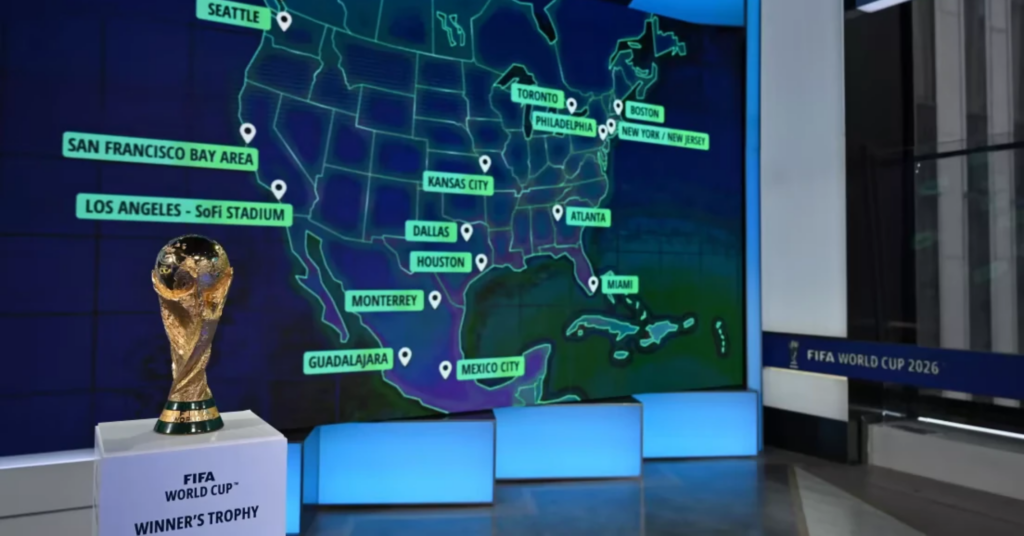
Thirty-nine days. Eleven cities. Billions of dollars in economic activity. And for European companies watching from the sidelines, something more valuable than any match result: a ready-made map of America’s most important commercial markets.
The World Cup host cities are not a random selection. They are the cities where corporate America has already concentrated. Here is what each one tells you about doing business in the US.
FIFA did not pick these cities for their stadiums alone.
Atlanta, Boston, Dallas, Houston, Kansas City, Los Angeles, Miami, New York/New Jersey, Philadelphia, San Francisco Bay Area, and Seattle. These are eleven of the most commercially significant markets in the United States.
Every one of them carries a specific industry identity, a talent pool, a cost profile, and a commercial character that matters to European companies deciding where to land.
This summer, the world watches matches in these cities. Millions of international visitors walk their streets, eat in their restaurants, and spend money in their economies. European brands already present will be part of that story. Those still deciding have a map, and this is it.
Here is what each city actually tells you about doing business in America.
Atlanta: The Corporate Capital of the American South

Who plays here at the World Cup? Spain plays in Atlanta. Morocco plays in Atlanta. Scotland plays in Atlanta.
Five facts about Atlanta that most European companies do not know:
- Atlanta ranks fourth among all US cities for Fortune 500 headquarters concentration, behind only New York, Chicago, and Houston
- Hartsfield-Jackson Atlanta International Airport is the world’s busiest airport by passenger volume for 2025, with 63.1 million scheduled seats (OAG, 2025), putting Atlanta within a two-hour flight of 80% of the US population
- Atlanta is home to 13 Fortune 500 companies generating $527.79 billion in annual revenue, including Home Depot, UPS, Coca-Cola, and Delta Air Lines
- Mercedes-Benz USA and Porsche Cars North America are both headquartered in metro Atlanta. Two of Germany’s most iconic brands chose the same city as their US base
- Georgia’s corporate tax rate dropped to 5.19% in 2025 and the state has no personal income tax, with Georgia ranked the number one state for workforce development
Atlanta is a logistics and connectivity powerhouse with a deeply international commercial culture. More than 2,700 international businesses and 40 bi-national chambers of commerce operate here. For European companies needing a southern US base with access to the whole country, Atlanta is the city your competition has already found.
Who belongs here: European companies in logistics, retail, automotive, consumer goods, corporate services, and any business that needs a southern hub with genuine global reach.
Boston: The World’s Life Sciences Capital

Who plays here at the World Cup? England plays in Boston. Norway plays in Boston. France plays in Boston.
Five facts about Boston that most European companies do not know:
- Boston’s Kendall Square has been called “the most innovative square mile on the planet”, with over 1,200 biotechnology companies operating in the greater Boston area alone
- Massachusetts has led all US cities in NIH funding for 22 consecutive years, receiving $3.46 billion in 2024, with Boston receiving the second-highest amount of any city in the country at $2.5 billion
- In 2024, Massachusetts-based biopharma companies raised $7.89 billion in venture capital, which was $220 million more than in 2023
- One in every 17 workers in greater Boston is employed in life sciences, the highest concentration per capita of life science professionals anywhere in the world
- Harvard and MIT sit within walking distance of each other and of the most concentrated cluster of pharma and biotech companies on earth. Moderna, Biogen, Vertex, Takeda’s US R&D base, and hundreds of others are all here
If you run a European life sciences, medtech, pharma, or health technology company, Boston is not a city you might consider. It is very likely the city you need to be in. The academic infrastructure, the talent pipeline, and the investment community are unmatched.
The cost of entry is high, but the alternative is building a US life sciences presence without access to the ecosystem that defines the industry. For a deeper look at where life sciences companies land in the US, read our guide on where your life science company should expand in the US.
Who belongs here: European life sciences, pharma, medtech, health technology, and financial services companies.
Dallas: The Number One City for Corporate Relocations in America
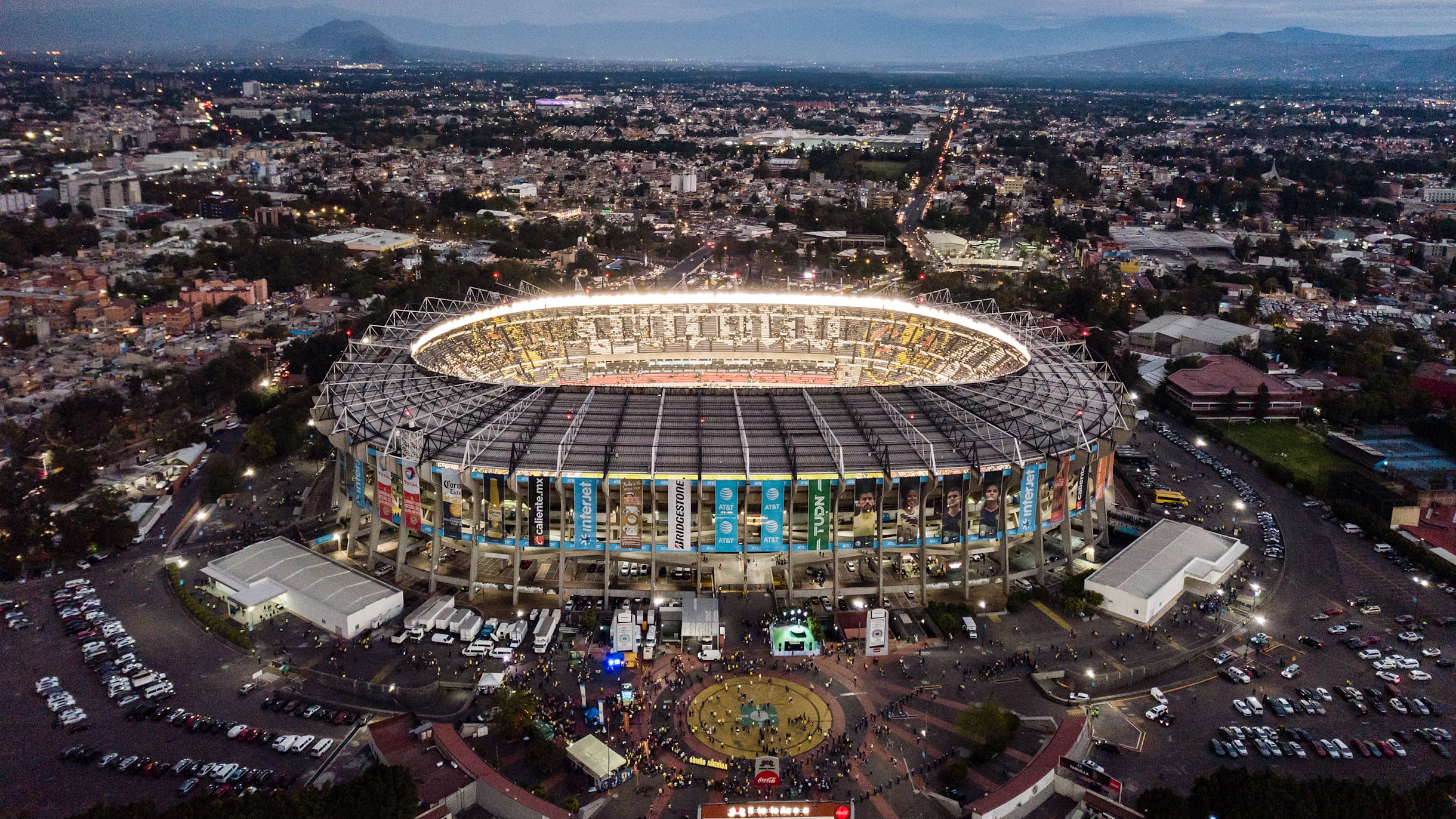
Who plays here at the World Cup? England plays in Dallas. The Netherlands plays in Dallas. Germany plays in Dallas. Argentina plays in Dallas.
Five facts about Dallas that most European companies do not know:
- According to CBRE, Dallas-Fort Worth was the number one US metro for corporate headquarters relocations from 2018 to 2024, attracting 100 new corporate headquarters, more than any other city in the country
- DFW is home to 21 Fortune 500 companies, including McKesson (Fortune 10), AT&T, American Airlines, and Texas Instruments
- AT&T Stadium in Arlington will host more World Cup matches than any other venue in the tournament, nine matches including a semifinal, giving Dallas extraordinary global visibility this summer
- Average office rent in Dallas-Fort Worth is $22 per square foot. In Midtown Manhattan, the same space costs over $83 per square foot. Texas has no corporate income tax and no personal state income tax
- DFW added 177,922 new residents between July 2023 and July 2024, reaching a total population of 8.3 million. Goldman Sachs is ramping up to 5,000 employees at a new Dallas office complex alone
Dallas is not a second-tier American city. It is where the smart money has been moving for the past decade, and where Goldman Sachs, Nasdaq, Oracle, and Tesla have all placed significant bets.
For European companies that need a southern US headquarters with low cost, central geography, and large-scale talent, the question is not whether Dallas should be on the list. It is why it is not already at the top.
Who belongs here: European companies in energy, financial services, technology, logistics, corporate services, and any business planning a major southern US headquarters.
Houston: The Energy Capital of the World
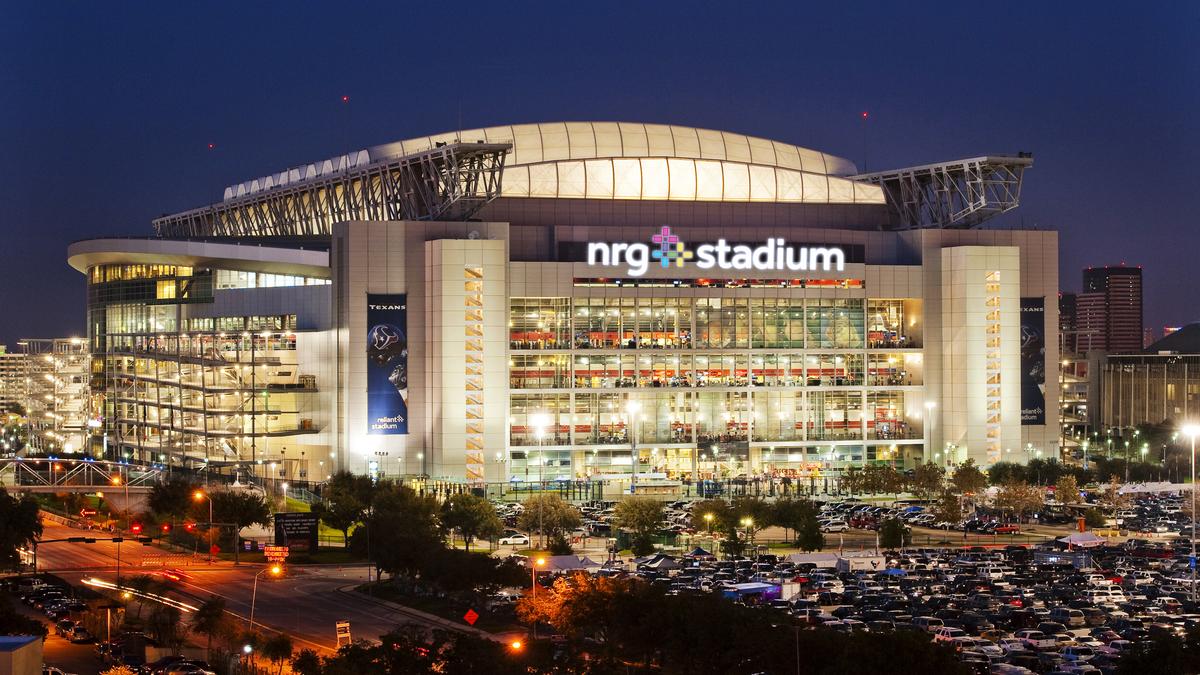
Who plays here at the World Cup? Germany plays in Houston. The Netherlands plays in Houston. Portugal plays in Houston.
Five facts about Houston that most European companies do not know:
- Houston is home to more than 4,600 energy-related firms and is the headquarters and intellectual capital for virtually every segment of the global energy industry, covering exploration, production, transmission, marketing, supply, and technology
- The city has 26 Fortune 500 company headquarters, ranking third in the country behind only New York and Chicago, including ExxonMobil, Chevron, and Hewlett Packard Enterprise
- Houston leads the United States in hydrogen production, producing 30% of US supply with over 900 miles of hydrogen pipelines, and hosts the US Department of Energy’s Gulf Coast Hydrogen Hub
- BP, Shell, ConocoPhillips, and Saudi Aramco’s Americas headquarters all operate from Houston’s Energy Corridor. If your European company touches energy in any form, your US industry peer group is already here
- The Texas Medical Center, the world’s largest medical complex, employs over 106,000 people and generates massive demand for life sciences, medtech, and healthcare services companies
No European energy, cleantech, or petrochemical company should be building a US presence without seriously evaluating Houston. The concentration of expertise, deal-making infrastructure, and sector-specific talent is unlike anywhere else in the world. The city also has no personal state income tax and a cost of living well below coastal averages.
Who belongs here: European energy, clean tech, petrochemical, engineering, life sciences, and healthcare companies.
Kansas City: The Affordable Centre of the Entire Country
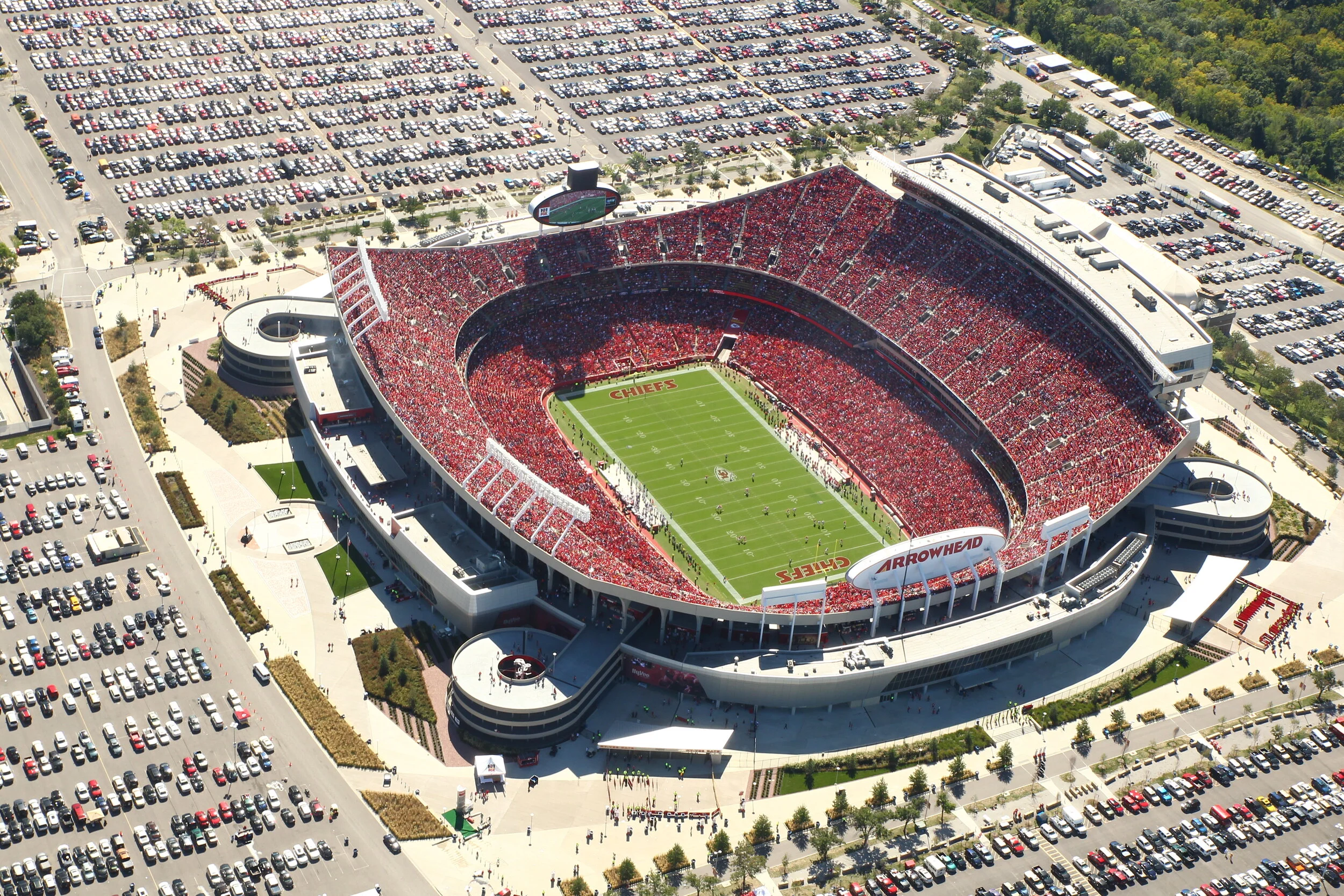
Who plays here at the World Cup? Argentina plays in Kansas City. The Netherlands plays in Kansas City. Austria plays in Kansas City.
Five facts about Kansas City that most European companies do not know:
- Both the geographic and population centres of the United States lie within 250 miles of Kansas City. No other major US city sits closer to the entire national market
- CBRE ranked Kansas City the number two most cost-effective tech market in the United States in 2024, measuring wages and office rent costs across large metros
- The metro’s total GDP is $152.8 billion (St. Louis Federal Reserve data), with an unemployment rate of 4.4% as of July 2025 and an economy diversified across healthcare, manufacturing, technology, and finance
- The median home price in Kansas City is around $285,000 and a two-bedroom apartment averages $1,250 per month, costs that make it dramatically easier to attract and retain US talent compared to coastal markets
- Kansas City is the number one US city in the West North Central Region for food manufacturing (ranked sixth nationally, 2025), and houses T-Mobile’s US headquarters, major animal health and agricultural biosciences operations, and a growing financial services cluster
Kansas City is the city that smart European companies discover second, and usually wish they had found first. The talent-to-cost ratio is exceptional. The central location serves the whole country. The business environment is welcoming and the quality of life is genuinely high. It will not make headlines the way New York or San Francisco does. That is partly the point.
Who belongs here: European companies in food and beverage, agricultural technology, logistics, financial services, and any business that needs US geographic centrality without coastal costs.
Los Angeles: America’s Most International and Commercially Diverse City
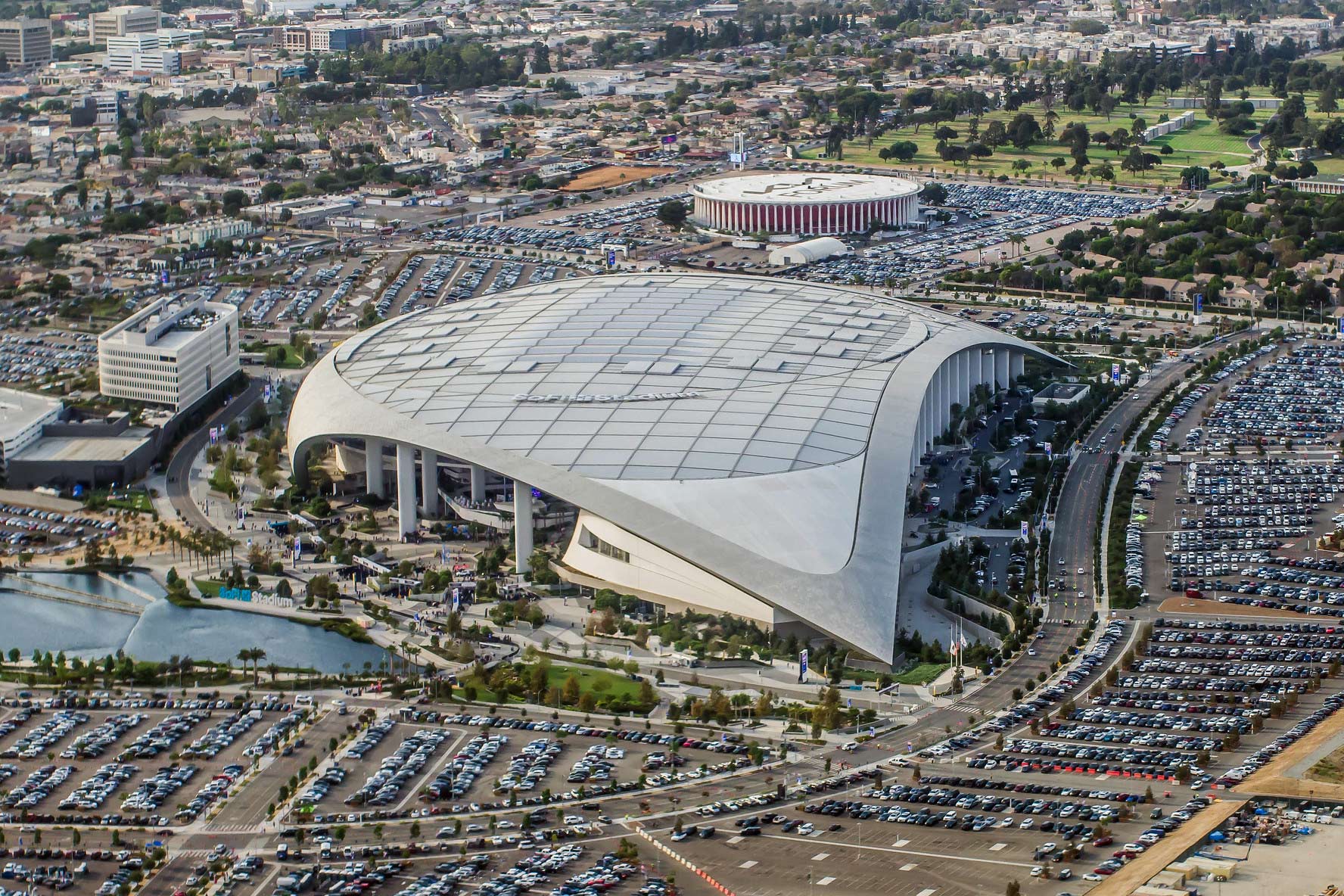
Who plays here at the World Cup? USA plays in Los Angeles. Belgium plays in Los Angeles. Switzerland plays in Los Angeles.
Five facts about Los Angeles that most European companies do not know:
- Los Angeles County real GDP growth was projected at 2.1% in 2025, and the LA metro area is the second largest economy in the United States by metropolitan GDP, meaning it is the second largest market you can be in
- The Port of Los Angeles and Port of Long Beach combined form the largest port complex in the Western Hemisphere, making LA the primary US gateway for international trade with Asia and the Pacific
- The United States’ opening World Cup match against Paraguay takes place at SoFi Stadium in Inglewood on June 12. The single most-watched US sporting event of 2026 happens in this city
- California is home to 58 Fortune 500 companies (Fortune 2025) and the state’s economy alone at $4 trillion ranks fourth in the world, larger than Germany and Japan
- Los Angeles has nearly 140,000 tech workers alongside its entertainment, media, fashion, and international trade sectors. It is the only US city where technology, entertainment, and global commerce all operate at world scale simultaneously
Los Angeles is expensive, and California’s regulatory environment adds complexity that European companies should plan for.
Neither of those facts changes the commercial reality: this is the second largest US economy, the home of global entertainment and media, a major technology hub, and the closest major US city to the world’s fastest-growing markets in Asia. European consumer brands, media companies, and technology companies building a US West Coast presence start here.
Who belongs here: European companies in entertainment, media, creative industries, consumer brands, technology, fashion, and international trade.
Miami: The Gateway Between America and Latin America
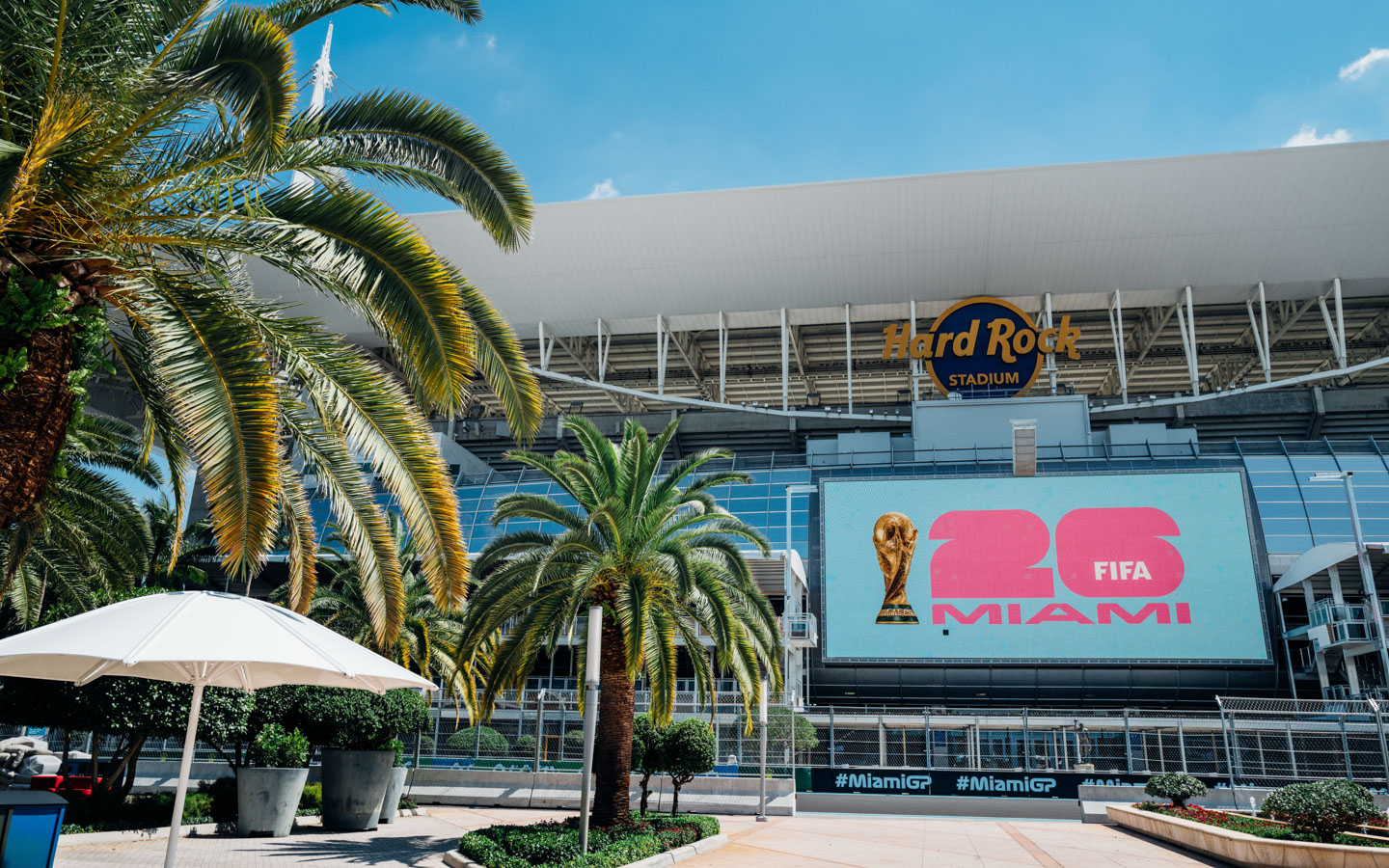
Who plays here at the World Cup? Portugal plays in Miami. Colombia plays in Miami. Scotland plays in Miami. Spain plays in Miami.
Five facts about Miami that most European companies do not know:
- One-third of all US exports to Latin America and the Caribbean come through Miami. The city handles 83% of all US air imports from Latin America via Miami International Airport and is the undisputed commercial bridge between the US and Latin America
- Miami has more international banks than any US city south of New York, with over 60 international banks operating in the Brickell financial district, which is increasingly known as “Wall Street South”
- The Global Financial Centres Index placed Miami at number seven in the United States and number 24 worldwide in 2025, and more than 30 major corporations either relocated to or significantly expanded South Florida operations in 2024 and 2025, including Microsoft’s Latin America headquarters
- Miami’s population is 70% Hispanic-heritage, over 2.7 million residents, and more than 90% of all data flowing across Latin America passes through Miami’s data centres. The city’s bilingual commercial infrastructure is unlike anything else in the US
- Miami has 2,500 startups, 90,000 jobs, and six-plus unicorns in its tech ecosystem, valued collectively at $95 billion. It is no longer simply a tourism and real estate economy
For European companies with existing Latin American operations or ambitions, Miami is the most strategically rational US base in the country. It is not just a gateway to Latin America. It is the gateway. No other US city gives you this combination of Latin American commercial access, international financial infrastructure, and growing technology presence.
Who belongs here: European companies with Latin American operations or ambitions, financial services firms, technology companies, and any business that needs bilingual US commercial capability.
New York / New Jersey: The Centre of Global Commerce

Who plays here at the World Cup? France plays here. Norway plays here. England plays here. The World Cup Final is here.
MetLife Stadium in East Rutherford hosts the Final on July 19. Eight group stage matches. The most-watched sporting event in human history takes place 25 minutes from Midtown Manhattan.
Five facts about New York that most European companies do not know:
- New York City has the most Fortune 500 headquarters of any city in the world. 49 Fortune 500 companies are headquartered in the New York metro area (RealPage 2025), including JPMorgan Chase, Citigroup, Goldman Sachs, and Morgan Stanley
- The Global Financial Centres Index ranked New York number one in the world as of 2025, ahead of London and Hong Kong. Wall Street’s bonus pool hit a record $47.5 billion in 2024, a 34% increase year-over-year
- New York City had a record 4.861 million jobs in January 2025, up 148,000 since February 2020. Wall Street employment rose to 201,500 finance industry jobs, the highest level in nearly three decades
- New York’s subway ridership has recovered strongly since the introduction of congestion pricing, and hotel occupancy reached 85%, well above the national average of 63%, reflecting the city’s return to full commercial activity
- For European companies, New York is where US clients make decisions, US investors deploy capital, and US partnerships form. Operating remotely from Europe into the New York market without a physical presence is a structural competitive disadvantage
New York is the most expensive major US city in which to operate. It is also the city where the most consequential relationships in US business are built. For European companies in financial services, professional services, media, life sciences at scale, and technology, the question is not whether to be in New York. It is how to structure your presence to make the costs defensible.
Who belongs here: European companies in financial services, asset management, legal and professional services, consumer brands, media, life sciences, and technology at scale.
Philadelphia: The Underrated Pharma Capital of the East Coast

Who plays here at the World Cup? France plays in Philadelphia. England plays in Philadelphia. Croatia plays in Philadelphia.
Five facts about Philadelphia that most European companies do not know:
- Greater Philadelphia is ranked number four in the US for life sciences market size (Colliers 2025) and is home to over 1,200 life sciences companies, including the US and regional headquarters of AstraZeneca, Bristol Myers Squibb, GSK, Johnson & Johnson, and Merck
- Pennsylvania’s life sciences sector employs 100,000 workers across nearly 3,100 companies that have secured more than 10,700 new life sciences patents over the past five years (PharmaVoice, 2025)
- GSK committed $2 billion to a new Pennsylvania manufacturing facility in 2025, building a new biologics flex factory in Upper Merion focused on respiratory disease and cancer medicines. It is a direct signal of where Europe’s largest pharma companies are investing in the US
- Philadelphia has the lowest office rental rates among the top 10 largest US metros , giving European life sciences companies access to a top-tier pharma cluster at costs significantly below Boston, New York, San Francisco, and San Diego
- Philadelphia trained more US doctors than any other city in history and hosts 15 major health systems alongside world-class research institutions including Penn Medicine and Jefferson Health. The clinical research and trial infrastructure here is among the deepest in the country
Philadelphia is the city European pharma and medtech companies land in when they have done their homework properly. The cluster is established, the talent is world-class, and the cost differential versus Boston is significant. If you are a European life sciences company evaluating your first US office, Philadelphia deserves to be on the shortlist.
Who belongs here: European pharma, biotech, medtech, life sciences, logistics, and professional services companies.
San Francisco Bay Area: The Technology Capital of the World
Who plays here at the World Cup? Switzerland plays in San Jose. Belgium plays in San Jose. Austria plays in San Jose.
Five facts about the San Francisco Bay Area that most European companies do not know:
- The Bay Area is home to Apple, Alphabet, Meta, Nvidia, Salesforce, and hundreds of the world’s most valuable technology companies. California’s information sector alone generates $134 billion in gross regional product in the greater Seattle area, and the Bay Area’s information GDP dwarfs that figure
- California’s economy at $4 trillion ranks fourth in the world, larger than Germany and Japan combined, and the Bay Area accounts for a disproportionate share of that output through technology, venture capital, and innovation
- The Bay Area is where US venture capital concentrates. If you are a European technology company that needs US investors, US enterprise customers, or US credibility in global technology, proximity to this ecosystem is not optional
- Microsoft ranked number one on Forbes’ 2025 tech employer rankings, but it is based in Redmond, near Seattle, not the Bay Area. This illustrates that Seattle is increasingly a genuine alternative for European technology companies (see below) that want to avoid the Bay Area’s cost premium
- California lost more corporate headquarters in 2024 than any other state, with 17 companies announcing relocations and 12 of them going to Texas. The Bay Area’s structural position in global technology remains unchanged because the talent, capital, and customer concentration is irreplaceable
The Bay Area is difficult and expensive. Office space in San Francisco is among the most costly in the world. The broader California regulatory environment adds operational complexity.
None of that changes the fundamental: if your European technology company needs to be taken seriously in global tech, and if your target customers, investors, and partners are concentrated here, operating remotely from Amsterdam or London is a structural disadvantage.
Who belongs here: European technology companies, AI and deep tech companies, venture-backed startups, and any business that needs credibility with the US technology investment community.
Seattle: Technology, Aerospace, and the Pacific Gateway

Who plays here at the World Cup? USA plays in Seattle. Belgium plays in Seattle. Switzerland plays in Seattle.
Five facts about Seattle that most European companies do not know:
- Seattle is home to Amazon, Microsoft, and Boeing, the three largest employers in Washington State, alongside Costco, Starbucks, Nordstrom, and Expedia, making it one of the most concentrated collections of globally significant company headquarters in any single US city
- Seattle ranks number two in the US for tech talent, with average tech worker compensation reaching $172,009 per year (CBRE Scoring Tech Talent report). Software engineers at Amazon in the greater Seattle area earn a median total compensation of $260,000 (Levels.fyi 2025)
- Washington State has no personal state income tax. For a European company hiring senior US technology talent, this is a meaningful competitive advantage in attracting people from California and New York
- Seattle’s information sector generates $134 billion in gross regional product (Greater Seattle Economic Report 2024), making it one of the most productive technology economies in the world per capita
- The Port of Seattle is a major Pacific Rim gateway. Seattle sits closer to Tokyo and Seoul than any other major continental US city, making it the natural US base for European companies that also need to manage Asia-Pacific operations
Seattle is often treated as a junior version of San Francisco. That misreads it. It is a distinct technology ecosystem with a different character, more focused on enterprise software, cloud computing, aerospace, and Pacific trade than on consumer applications and social platforms.
The talent is exceptional, the costs are lower than San Francisco, and the strategic position for companies with global operations is differentiated. For a broader look at where technology talent concentrations sit across the US, including some markets that rarely make the shortlist, read our guide to smart tech talent hotspots for US expansion in 2026.
Who belongs here: European technology companies, aerospace and advanced manufacturing companies, and businesses that need to manage US and Asia-Pacific operations from a single base.
What This Map Tells You
These eleven cities are not interchangeable. They represent fundamentally different business landscapes, industries, cost profiles, and commercial cultures. The right city for your European business depends on what you sell, who you sell to, what talent you need, and what your first twelve months in the US actually require.
What the World Cup has done is focus the world’s attention on all eleven simultaneously, for 39 days, in a way that will not happen again for a generation. Individual host cities are projected to see between $160 and $620 million in incremental economic activity from the tournament alone. The companies already present will be part of that story. Those still deciding have a map and a deadline.
Foothold America works with European companies entering every one of these markets. We understand the employmen law, the hiring landscape, the cost structures, and the operational requirements of each state.
Whether you are deciding between Dallas and Houston, Boston and Philadelphia, or evaluating the Bay Area against Seattle, our team gives you the honest commercial picture, not the brochure version.
If you want to understand which of these cities makes the most sense for your business before June 11, contact Foothold America today.