



It depends entirely on the state. There is no federal ban. The FTC’s rule was struck down and removed from the regulations on 12 February 2026. Four states void employee non-competes outright, Washington voids all of them from June 2027, Virginia kills them on a no-cause termination, and Florida now allows four years.
For a UK or European company, the instinct is to reuse the restrictive covenant from the home contract. That instinct is the problem. A clause that is merely unenforceable in London can be a civil violation in California.
What is a non-compete agreement?
A non-compete is a clause that stops a departing worker from joining a competitor or starting a competing business for a set period, in a set area, in a set line of work. It is one of four restrictive covenants US employers use, and it is the weakest of them.
| Covenant | What it restricts | How well it holds up |
|---|---|---|
| Non-compete | Working for a competitor at all | Weakest. Void in several states, restricted in many more. |
| Non-solicitation of customers | Approaching your clients | Stronger, though capped at 18 months in Washington from 2027. |
| Non-solicitation of employees | Poaching your staff | Generally stronger. Watch no-hire agreements, which the FTC has challenged. |
| Confidentiality and trade secrets | Using or disclosing your information | Strongest. Survives even the California and Washington bans. |
Companies reaching for a non-compete usually want one of the other three. That is worth knowing before you draft anything, because the other three travel across state lines far better.

What test do US courts actually apply?
Where non-competes are allowed, courts ask whether the restriction is reasonable. Reasonableness is assessed on three axes, and a covenant has to clear all three:
- Duration. How long the restriction runs.
- Geography. The area it covers.
- Scope of activity. The work it stops the person doing.
Cornell’s summary of the case law puts the test plainly: non-competes are permitted “so long as the scope of the restrictions are reasonable.” The classic illustration is Karpinski v. Ingrasci, where a permanent restriction over a small area was upheld, but restricting the dentist from general dentistry as well as oral surgery was too broad.
Two further requirements sit underneath the reasonableness test, and they are where most home-country contracts fail.
Legitimate business interest. The restraint cannot be “greater than is necessary to protect the goodwill or other business interest” of the employer. Wanting to keep someone is not a business interest. Protecting client relationships, confidential pricing or trade secrets is.
Consideration. The employee has to get something for signing. In several states, continued employment alone is not enough. Illinois codified a two-year rule: absent other consideration, the employee must stay employed for two years after signing for the covenant to be supported. Pennsylvania requires meaningful consideration beyond continued at-will employment. If you ask an existing US employee to sign a non-compete on a Tuesday and give them nothing for it, you may have nothing.
Do non-competes hold up in court?
Sometimes, and what happens to an overbroad one depends on the state. There are three judicial approaches, and the difference between them is the difference between a covenant that gets trimmed and one that disappears.
| Approach | What the court does | Effect on you |
|---|---|---|
| Red pencil | Refuses to rescue an overreaching agreement and voids the whole thing | Draft narrow or lose everything |
| Blue pencil | Strikes out offending words but will not rewrite | Deletion works, rewording does not |
| Reformation | Actively rewrites the clause to something enforceable | The most forgiving of sloppy drafting |
Georgia, Ohio and Michigan courts will modify. That is why a covenant that would be dead in one state gets quietly trimmed and enforced in another.
Is there a federal ban on non-competes?
No. The FTC issued a rule in 2024 that would have banned most employee non-competes nationally. A federal court in Texas set it aside before it took effect.
On 5 September 2025 the FTC voted 3 to 1 to dismiss its appeals in Ryan, LLC v. FTC and Properties of the Villages v. FTC, and to accede to the vacatur. On 12 February 2026 it removed the rule from the Code of Federal Regulations at 16 CFR part 910.
The rule is gone. That is not the same as the FTC losing interest.
The FTC still enforces case by case
The agency swapped rulemaking for enforcement under Section 5 of the FTC Act:
- Gateway Services, September 2025. A pet cremation company with around 1,800 employees, ordered to stop enforcing non-competes that barred work anywhere in the US for a year.
- Adamas Amenity Services. Ordered to stop enforcing no-hire agreements covering New Jersey and New York City.
- Rollins, Inc., 15 April 2026. A pest control company barred from enforcing non-competes against more than 18,000 current and former workers. The FTC followed with warning letters to 13 other pest control companies.
The pattern is consistent. Broad covenants applied across a whole workforce attract attention. Narrow covenants over genuinely sensitive roles do not. The FTC also runs a public inbox for people to report non-competes, which means a disgruntled leaver has a route that costs them nothing.
Non-compete laws by state
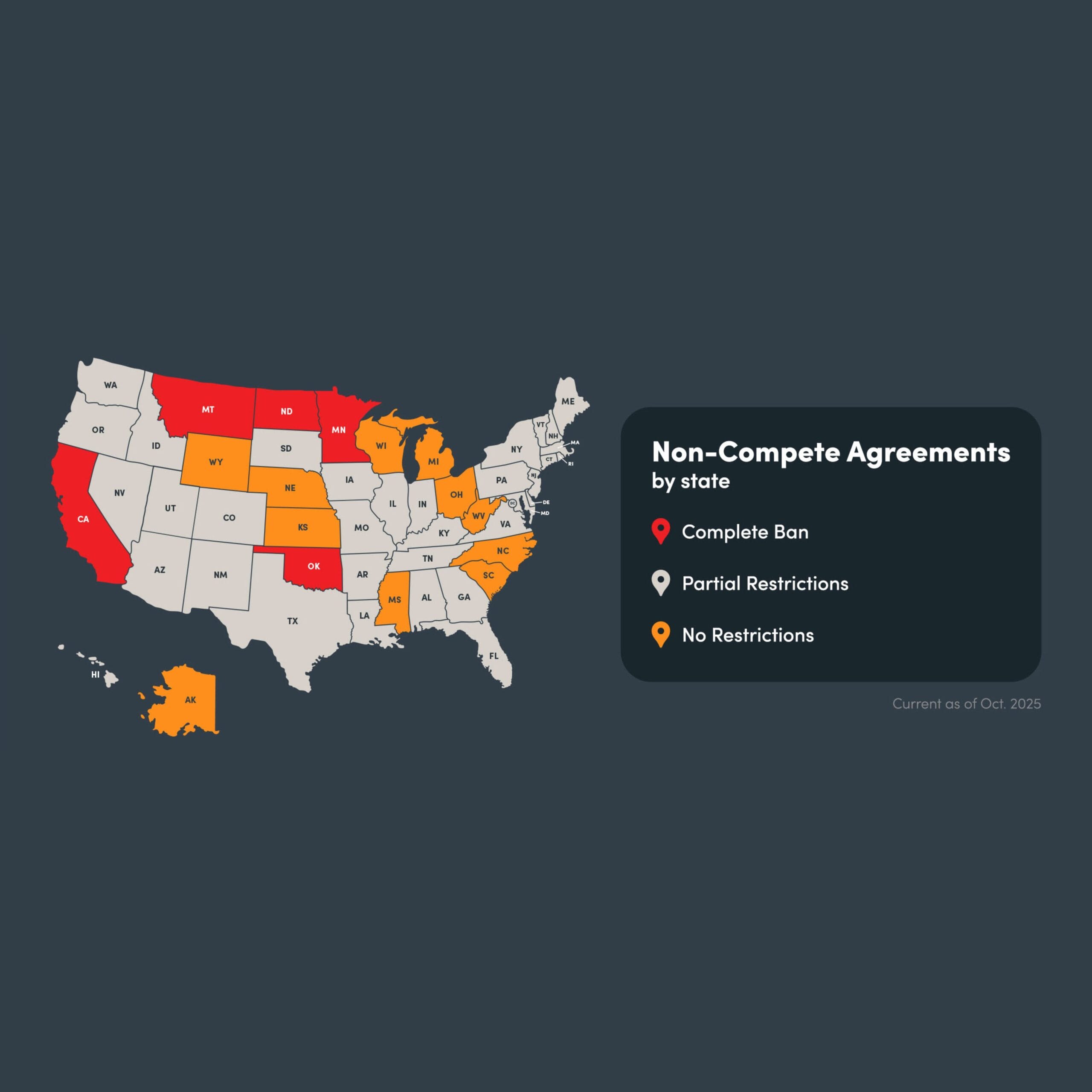
| State | Enforceable? | What governs it |
|---|---|---|
| California | No | Bus & Prof Code 16600. SB 699 voids them regardless of where signed. Employees can sue. |
| Minnesota | No | Minn. Stat. 181.988, for agreements entered into on or after 1 July 2023. |
| North Dakota | No | Long-standing statutory prohibition. |
| Oklahoma | No | Long-standing statutory prohibition. |
| Wyoming | Mostly no | SF 107, from 1 July 2025. Executive and management personnel excepted. Not retroactive. |
| Washington | Yes, until 2027 | ESHB 1155 voids all of them from 30 June 2027, existing agreements included. |
| Illinois | Above $75,000 | Freedom to Work Act. Rises to $80,000 on 1 January 2027. |
| Colorado | Above $130,014 in 2026 | Non-solicitation threshold is $78,008.40. Both indexed annually. |
| Virginia | Above $78,364.52 in 2026 | From 1 July 2026, also unenforceable after a no-cause termination without severance. |
| Massachusetts | Yes, with conditions | 12 months maximum, garden leave or other agreed consideration, 10 business days’ notice. |
| Pennsylvania | Yes, with conditions | Needs consideration beyond continued at-will employment. Healthcare practitioners exempt since 2024. |
| New York | Yes | No statute. Common law reasonableness. |
| Texas | Yes | Bus & Com Code 15.50. |
| Georgia | Yes | Restrictive Covenants Act. Courts blue-pencil. |
| Ohio | Yes | Common law reasonableness. Courts modify. |
| Michigan | Yes | Reasonableness review. Courts modify. |
| Florida | Yes, strongly | CHOICE Act from 1 July 2025. Up to four years. |
Are non-competes enforceable in California?
No. California voids them, and it is the only state that punishes you for trying. Under SB 699, effective 1 January 2024, a contract void under California law is unenforceable regardless of where and when it was signed. Attempting to enforce one is a civil violation, and current, former and prospective employees can sue for injunctive relief, damages and attorneys’ fees.
Read that again with a UK contract in mind. A covenant drafted in London, signed in London, governed by English law, applied to someone who later works in California, is not simply unenforceable. Trying to enforce it creates a claim against you. Choice-of-law and choice-of-forum clauses do not rescue this. California legislated specifically against that route.
Are non-competes enforceable in Texas?
Yes. Texas is one of the more employer-friendly states. Under Business and Commerce Code section 15.50, a covenant is enforceable if it is ancillary to an otherwise enforceable agreement and contains limits on time, geographical area and scope of activity that are reasonable and no greater than necessary to protect the employer’s goodwill or business interest. Physicians get extra statutory protections, including a buyout option.
Are non-competes enforceable in New York?
Yes, under common law rather than statute. New York courts apply the reasonableness test. The legislature passed a near-total ban in 2023, S3100, and Governor Hochul vetoed it in December 2023, saying she preferred a threshold-based approach. A narrower bill was reintroduced on 6 April 2026, aimed at workers earning $500,000 or more and at health professionals. Nothing has been enacted, so the common law still governs.
Are non-competes enforceable in Florida?
Yes, and more so than anywhere else. The CHOICE Act took effect on 1 July 2025 and is now the most employer-friendly restrictive covenant law in the country. It allows non-compete and garden leave agreements of up to four years, double the previous practical limit, for workers earning more than twice the annual mean wage in their Florida county. That works out around $100,000 depending on the county.
Conditions apply. The agreement must be in writing. The worker gets at least seven days to review it, with written notice of their right to consult a lawyer. There must be written acknowledgement that they received confidential information or held substantial client relationships. Garden leave cannot require the worker to perform duties beyond the first 90 days.
Are non-competes enforceable in Illinois?
Only above $75,000 in annualised earnings, rising to $80,000 on 1 January 2027, then $85,000 in 2032 and $90,000 in 2037. The Freedom to Work Act also requires you to give the employee at least 14 calendar days to review the covenant and to advise them in writing to consult a lawyer. Miss either step and the covenant is unenforceable no matter what the employee earns.
Are non-competes enforceable in Colorado?
Only above $130,014 in 2026. Non-solicitation agreements have a separate, lower threshold of $78,008.40. Both figures are indexed and move every year, so any number you were given last year is already wrong.
Are non-competes enforceable in Virginia?
Only above $78,364.52 in 2026, and from 1 July 2026 there is a second test. A non-compete is unenforceable if the employer terminated the employee without cause and did not provide severance or other payment.
That is the single most important line in this article for an international employer. Restructure a US team, let someone go without cause, pay them nothing on the way out, and the covenant you were relying on is gone. Since there is no federal severance entitlement and severance rules vary by state, this is a decision that gets made in the moment and rarely gets checked against the contract.
Are non-competes enforceable in Georgia, Ohio, Michigan or Pennsylvania?
Yes in all four, subject to a reasonableness test. Georgia, Ohio and Michigan courts will modify an overbroad covenant rather than strike it, which makes them among the friendlier states for employers. Pennsylvania is stricter on consideration and has voided non-competes for physicians, nurse practitioners, dentists and other licensed clinicians since 2024.
Are non-competes enforceable in Massachusetts?
Yes, within tight limits. The Noncompetition Agreement Act caps most covenants at 12 months, extending to two years only where the employee breached a fiduciary duty or took company property. You must either pay garden leave of at least 50 percent of the employee’s highest annualised base salary through the restricted period, or give other mutually agreed consideration. New hires must get the agreement with the offer letter or 10 business days before their start date, whichever is earlier. It cannot be enforced against FLSA non-exempt employees, student interns, or anyone 18 or under.
Are non-competes enforceable in Washington?
For now, above an annually indexed wage threshold. Not for much longer. Engrossed Substitute House Bill 1155 was signed on 23 March 2026 and takes effect on 30 June 2027. It voids all non-competition covenants with employees and independent contractors regardless of when they were signed, which includes agreements already in place. Non-solicitation carve-outs are capped at 18 months. Sale-of-business covenants, confidentiality agreements and franchise agreements survive. Workers must be notified by 1 October 2027, and a worker can recover actual damages or $5,000, whichever is greater, plus costs and fees.
If you employ anyone in Washington, that is a diary entry, not a detail.
What international employers should do instead
Two employees doing the same job in Tampa and Seattle will be on completely different footing by 2027. There is no US position on this question, only fifty of them, and they move every legislative session.
The practical response is not a better non-compete. It is a different set of tools:
- Confidentiality and trade secret agreements. These survive even the California and Washington bans.
- Narrow non-solicitation clauses, sized to the state.
- Assignment of inventions and work product.
- Notice periods and garden leave, where state law allows them.
- State-specific covenant language, not one clause applied nationally.
Whichever you use, the covenant belongs in a US-law employment document rather than an adapted home-country contract. Our guide to US employment letters covers what those documents need to contain.
Two pieces of context matter alongside this. US employment is at-will in 49 states, so the relationship you are trying to protect can end at any time on either side. And if you employ people in more than one state, the same lesson applies here as to policy documents generally: a single template applied across the country will be wrong somewhere, which is why handbook templates fail in multi-state US operations.