


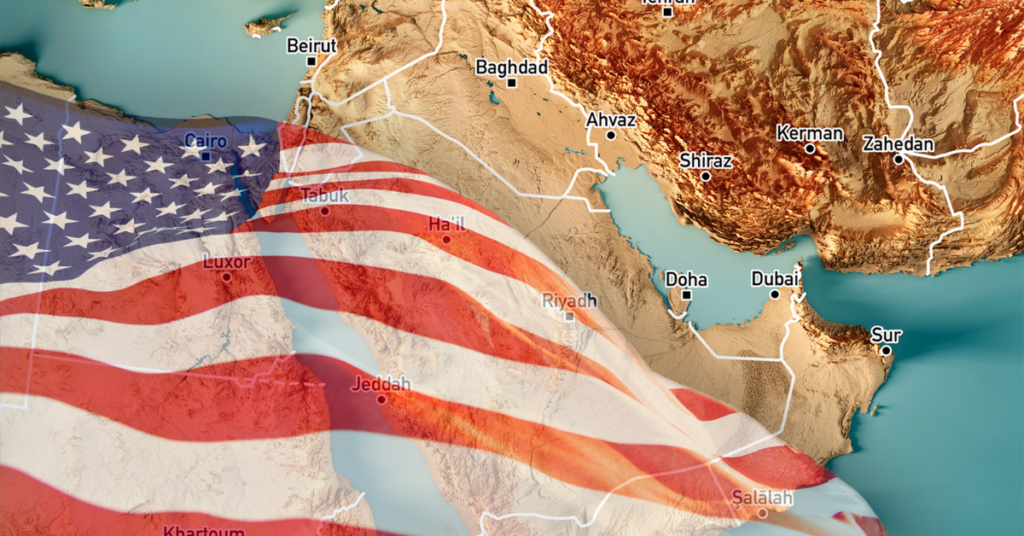
On February 28, 2026, the United States and Israel launched coordinated military strikes on Iranian military and nuclear infrastructure. Within hours, the Strait of Hormuz was functionally impaired.
Brent crude surged toward $120 a barrel. Dutch TTF natural gas futures jumped 59% from pre-conflict levels. Qatar’s LNG output halted. Dubai International Airport suspended operations as Middle Eastern airspace closed.
Three weeks on, none of that has fully resolved.
If you are a European business leader with a US expansion decision on the table, you are asking yourself whether now is the right moment. That is a fair question. Here is an honest answer.
What Is Actually Happening
This is not background noise. The conflict is real and its economic consequences are already measurable.
The Strait of Hormuz normally carries around 20% of daily global oil and LNG production. Since it was disrupted, the effects have spread well beyond energy markets.
Deloitte Insights reported on March 23 that Brent crude prices were up 39% from pre-conflict levels as of March 12, that Dutch TTF natural gas futures had risen 59%, and that fertiliser prices were up 34%. The Center for Strategic and International Studies estimated the cost of the first 100 hours of the conflict at $3.7 billion to the US alone, most of it unbudgeted.
The World Trade Organisation published its Global Trade Outlook on March 19. It forecast global merchandise trade growth would slow to 1.9% in 2026, down from 4.6% in 2025. It explicitly cited the Middle East conflict as the factor most likely to push that figure lower still.
Goldman Sachs warned that if the Strait remains blocked for more than two months, European natural gas prices could more than double from pre-conflict levels. They have already come close.
The European Central Bank, which had been expected to cut interest rates further through 2026, postponed those cuts on March 19 and raised its inflation forecast.
Economists are now warning that energy-intensive European economies face a risk of technical recession if the blockade persists through summer.
That is the landscape. It should not be dressed up as anything other than what it is.
Why European Companies Are More Exposed Than US Ones
If your business is based in the UK, Germany, the Netherlands, or wider Europe, this conflict hits you harder than it hits your American competitors. That is not conjecture. It is the consensus of every serious economic institution that has published analysis since February 28.
Chatham House’s assessment from March is worth reading in full. In a prolonged conflict scenario, it projects the eurozone economy would contract in the second quarter and then flatline through the second half of the year.
In the same scenario, the US economy fares better, experiencing a slowdown rather than contraction. Economists forecast that the US will outperform other major economies, with growth of around 2.25% in 2026, even under pressure. Eurozone growth in that scenario falls to around 0.5%.
The underlying reason is structural. The US has been a net energy exporter since 2019. Domestic oil production stands at 13.4 million barrels per day, 22% higher than five years ago. RSM chief economist Joe Brusuelas wrote on March 2 that oil price spikes no longer present the same downside risk to US GDP as they did a generation ago.
He noted that the US’s status as a net energy exporter may actually bolster US GDP as LNG flows to European and Asian buyers are disrupted.
Capital Economics put the arithmetic plainly. Every $10 increase in a barrel of oil adds around 0.2 percentage points to US inflation and causes a 0.1% drag on US growth. The same increase hits European manufacturers, who are import-dependent, far more directly and with no domestic production base to absorb the shock.
Europe started 2026 with gas storage at just 30% of capacity after a harsh winter. That made the timing of this conflict particularly damaging. The US had no comparable structural vulnerability.
What This Means for Your US Expansion Decision
Here is the part that some European business leaders find uncomfortable, and others find clarifying.
The conflict is creating real instability across European markets. It is not creating the same kind of instability inside the US domestic economy. The ECB is raising its inflation forecast and cutting growth projections.
The Federal Reserve has held rates steady. Markets now expect no more than one Fed rate cut in 2026, down from 2.6 cuts priced six weeks ago. That is a tighter environment than January. It is not a collapsing one.
The Eurasia Group noted in its Top Risks analysis that European business leaders were already moving toward expanding US operations before this conflict, specifically to reduce exposure to European political volatility and tariff risk.
The conflict sharpens that logic considerably. If you want a full breakdown of entry route options, our guide to US market entry strategies covers the decision in detail.
When your home market faces energy price shocks, currency depreciation, a central bank moving in the wrong direction, and an economy growing at 0.5% in the best-case scenario, the argument for having a US revenue stream is more compelling than it was in January. Not less.
That is not optimism. It is the direction the numbers point.
The Legitimate Concerns to Plan For
There are three real risks to factor in. Ignoring them would undermine the credibility of everything else.
Shipping and supply chain costs are elevated. If your US business model involves moving physical goods between Europe and the US, freight costs and war-risk insurance premiums are higher right now. That belongs in your planning and your pricing.
The Federal Reserve’s path is becoming less predictable. At the start of 2026, futures markets were pricing in a total of 65 basis points in reductions (roughly 2.6 cuts). As of mid-March, expectations have cooled significantly, with investors anticipating barely a single 25-basis-point cut. If you are entering the US market with a debt-dependent capital structure, you should model for a “higher-for-longer” interest rate environment.
The duration of the conflict is unknown. The Council on Foreign Relations reported on March 20 that the WTO warned sustained high energy prices could reduce 2026 global GDP growth by a further 0.3 percentage points.
Nobody honest can tell you when this resolves. Your plans should function under sustained uncertainty, not wait for certainty that may not come before summer.
None of these three things changes the fundamental case for US market entry. They do change how you structure it. Our 2026 US expansion checklist walks through exactly what to prepare for in the current environment.
What the Historical Record Shows
This is not the first time European companies have considered geopolitical shock as a reason to defer expansion decisions.
Companies that paused US market entry during the 2008 financial crisis spent years watching competitors build the client relationships and brand recognition that are hard to displace later.
Companies that pulled back during COVID discovered that the US market recovered faster than any other major developed economy. The pattern repeats across every major disruption of the past 30 years.
Geopolitical instability in the wider world does not permanently reduce the US as a market. It occasionally raises the cost of entry temporarily.
It does not change the fundamentals: the world’s largest economy at $27.7 trillion; a legal system that protects commercial agreements; a deep, mobile talent market; and a business culture that rewards companies that show up when others hesitate.
The companies that benefit most from stabilisation are those already operating when it arrives. For a practical look at how fast US market entry actually takes, read our breakdown of how EOR services accelerate US expansion timelines.
What You Can Do Right Now
You cannot control the Strait of Hormuz. You can control whether your business has US infrastructure in place when this period resolves.
Employer of Record removes the timeline obstacle entirely. Foothold America can have your first US employee compliant and operational within days, with no entity formation required. If the question is boots on the ground before conditions shift, EOR is the direct route.
Entity setup through Delaware incorporation and state registration takes four to six weeks when managed properly. You do not need geopolitical clarity to begin this process. It is shorter than most news cycles right now.
Virtual Office gives you an immediate US business address, local telephone number, and professional market presence while entity setup completes.
None of these commitments are irreversible. All of them build forward momentum at a moment when your competitors are doing exactly what you are considering: waiting.
The Bottom Line
The Middle East conflict is serious. Europe is more exposed to it than the United States is. That is the finding of Deloitte, Chatham House, Capital Economics, the WTO, the ECB, and the WEF. None of them is being alarmist.
A business generating revenue in US dollars is more insulated from European energy volatility than one that does not. A business with US clients, US employees, and a US entity has a geographically diversified footprint that protects it against the asymmetric shocks the global economy is experiencing right now.
The instability you are watching does not go away by waiting. It goes away by building something that is not entirely dependent on the markets being disrupted.
If you want to understand what US market entry looks like right now, for your specific business, contact Foothold America. We have been helping European companies enter the US market through every kind of global disruption. This one does not change the answer.