



You have found the right US hire. They are based in Texas. You are based in London, Munich, or Amsterdam. You do not have a US entity. You cannot legally pay them yet. And you need them to start in four weeks.
This is the moment most international companies discover that hiring in the United States is nothing like hiring at home.
The US has no single national employment law. Labor rules are set by federal statute, by each of the 50 states, and in some cases by individual cities and counties. Payroll taxes vary by state. Benefits structures are fundamentally different from European norms. Workers’ compensation insurance is mandatory and state-regulated. Getting any of it wrong, whether that is misclassification, a missed state-specific notice requirement, or late tax remittance, carries real consequences.
An Employer of Record solves all of that. It lets you hire US employees legally, compliantly, and quickly, without spending months and significant money setting up an American entity first.
But how does it actually work? What happens at each stage? And what should you expect from the process?
This guide walks you through everything, step by step.
What Is an Employer of Record?
An Employer of Record (EOR) is a third-party company that becomes the legal employer of your US staff on paper, while you retain full day-to-day management and direction of those employees.
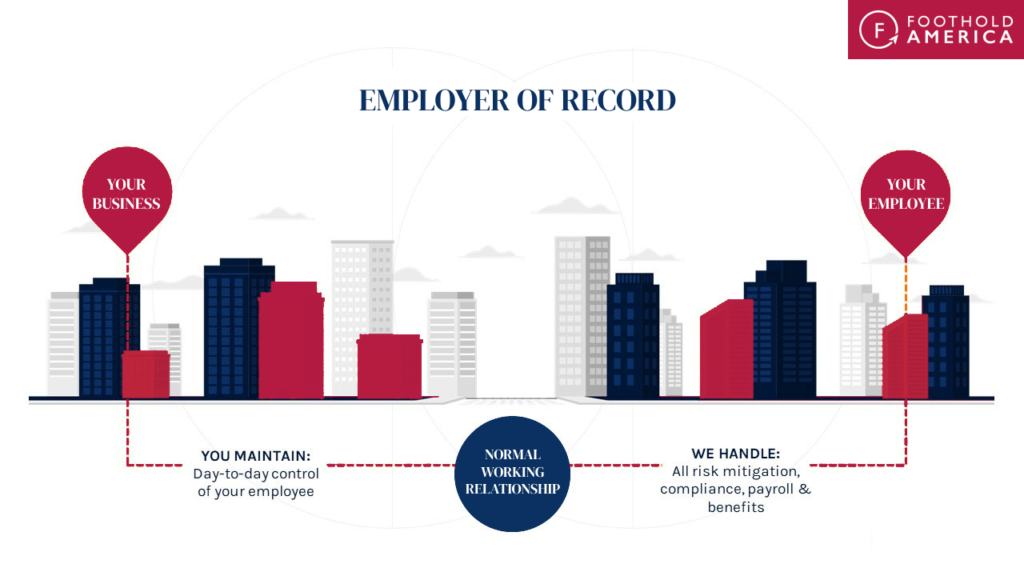
The EOR handles everything that employment law requires: registering as an employer in the relevant state, running payroll, withholding and remitting federal and state taxes, providing legally compliant benefits, maintaining employment records, and filing all required reports with the IRS and state agencies.
You choose who to hire. You set their role, their targets, and their ways of working. The EOR makes the employment legal.
This is not a contractor arrangement or a workaround. It is a fully compliant employment model used by thousands of international companies every year to build US teams before, or instead of, establishing a US entity.
The scale of EOR adoption reflects how central this model has become. According to Business Research Insights, the global EOR market is valued at $5.97 billion in 2026 and is projected to reach $10.45 billion by 2035, growing at a CAGR of 6.8%. One of the primary drivers of that growth is speed: research by Market Reports World confirms that EOR providers can deploy talent in as few as three to five working days, compared to the 30 to 90 days typically required for entity setup.
If you want to understand the foundational concepts before getting into the mechanics, our guide to Understanding Employer of Record Services is a good starting point. If you are weighing EOR against other employment models, our comparison of EOR vs PEO vs GEO explains the differences clearly.
Why International Companies Choose EOR for US Expansion
Setting up a US entity, typically a C Corporation or Limited Liability Company, takes time and money. You need to choose a state of incorporation, appoint a registered agent, file articles of incorporation or organization, obtain a federal Employer Identification Number, register for state payroll taxes in every state where you have employees, open a US bank account, and establish compliant payroll infrastructure. The process typically takes two to four months.
And when you add up legal fees, state filing costs, accounting setup, and benefits procurement, the upfront costs run well into five figures before you have paid your first US employee.
An EOR removes that overhead entirely. You can have a US employee on payroll within days, not months.
That speed matters enormously in competitive markets. We cover the timeline comparison in detail in our piece on how EOR services accelerate US expansion timelines. Companies that use an EOR consistently get to market faster than those that start by setting up an entity.
EOR is also the right tool for market testing. If you are not certain the US is the right move, or if you want to validate demand before committing to full incorporation, an EOR lets you test with a real employee in a real US role without the costs and long-term obligations of entity setup. Our strategy guide for using EOR for US market testing explains how to structure this approach properly.
How Employer of Record Works: The Step-by-Step Process
Here is exactly what happens when a company uses an EOR to hire US employees, from the first conversation to the point where your hire is fully onboarded and running.
Step 1: Initial Scoping and Needs Assessment
The process starts with a conversation. A real one, not an automated form.
At Foothold America, we begin every EOR engagement by taking the time to understand your business properly: where you are based, what you are trying to achieve in the US, which state or states your hires will work from, what roles you are filling, and what timeline you are working to. We ask these questions because the answers really do change how we structure things for you, and we think you deserve a service built around your situation, not a generic template.
This matters because the US is not a single employment market. A sales hire in New York operates under very different rules from one in Florida or Texas. Sick leave mandates, paid leave requirements, pay transparency laws, non-compete enforceability, and workers’ compensation rates all vary by state. Getting the structure right from the start protects both you and your new hire.
We also talk about your broader expansion goals. Are you hiring one or two people to test a market, or do you intend to build a substantial US team? Are you planning to set up a US entity eventually, or do you want to remain on EOR for the foreseeable future? The answers shape how we structure the service from day one, and being honest with us about where you are heading means we can plan ahead with you.
This is the stage where many EOR providers fall short. Automated platforms generate instant pricing and push you through an onboarding flow without ever asking the right questions. The US is too complex, and the stakes too high, for that approach. Real expertise at this stage saves significant time, cost, and stress later.
Step 2: Agreement and Service Setup
Once the scope is agreed, you sign a client service agreement with the EOR. This document sets out the commercial terms, the division of responsibilities between you and the EOR, and the data protection arrangements covering your employees’ personal information.
If you are selecting an EOR for the first time, it is worth reading the agreement carefully. Our guide to Understanding EOR Contracts walks through the key clauses, what to look out for, and what good versus poor contract terms look like. The most important things to understand are how liability is allocated, what happens to your employees if you exit the relationship, and what notice periods and exit provisions apply.
At this stage, the EOR also registers as an employer in the states where your hires will be located. This involves obtaining state employer registration numbers, setting up unemployment insurance accounts, and establishing workers’ compensation coverage. If your EOR is already registered in those states, this step is minimal. If not, registration adds days to the timeline, which is one reason to choose a provider with an established multi-state footprint.
Step 3: Offer Letter and Employment Agreement
The EOR issues the employment contract to your new hire. This is a critical document and one where US-specific expertise is essential.
US employment contracts look very different from UK or European ones. Employment is predominantly at-will in most states, meaning either party can end the relationship at any time without cause, subject to state-specific exceptions and any contractual protections. There is no statutory notice period in most states in the way that exists under UK law or EU directives.
The employment agreement must comply with the laws of the state where your employee will work, not the laws of your home country or the state where the EOR is headquartered. It needs to include the correct details on at-will status, compensation, benefits eligibility, confidentiality, intellectual property assignment, and any applicable non-compete or non-solicitation provisions.
Your EOR should provide a compliant template for the specific state and role, and you should have input on the commercial terms: the salary, any variable compensation, equity arrangements if applicable, and the scope of the role.
One common mistake is trying to incorporate UK-style employment terms into a US employment agreement. They are not compatible. An agreement that mixes legal systems creates ambiguity and risk. The US agreement needs to stand alone and comply with US law.
Step 4: Benefits Enrollment
This stage often surprises international companies more than any other. US employment benefits are not an optional extra. They are a significant part of your employee’s total compensation and a major factor in your ability to attract and retain good people.
Health insurance is the most significant. Unlike the UK’s NHS or Germany’s statutory health insurance system, the US has no universal healthcare coverage. Employers are expected to provide it, and the quality of coverage matters enormously to US employees. Under the Affordable Care Act, employers with 50 or more full-time equivalent employees are required to offer qualifying coverage. Even below that threshold, offering health insurance is effectively essential if you want to compete for talent.
The EOR provides access to a group health plan, which means your employees benefit from pooled rates that a small or early-stage business could not access independently. Your hire gets the same quality of coverage they would receive from a well-established employer, even if you only have one or two US employees at this stage.
Beyond health insurance, standard US benefits typically include:
- Dental and vision insurance
- Life and accidental death and dismemberment insurance
- 401(k) retirement savings plan, usually with employer matching
- Short-term and long-term disability insurance
- Paid time off, including state-mandated sick leave where applicable
The EOR manages open enrollment, handles employee elections, administers the plans throughout the year, and ensures COBRA continuation coverage is offered if an employee leaves.
If you want to understand how the benefits landscape compares to the PEO model for more established US operations, our piece on hiring employees in the USA with an Employer of Record service covers this in detail.

Step 5: Payroll Setup and First Payment
With the employment agreement signed and benefits elected, your employee is enrolled in the EOR’s payroll system.
US payroll is complex. Your EOR must calculate and withhold:
- Federal income tax, based on the employee’s W-4 elections
- Social Security tax at 6.2% of wages up to the annual wage base, shared equally between employer and employee
- Medicare tax at 1.45% of all wages, with an additional 0.9% on higher earnings
- State income tax, with rates and rules varying significantly by state
- State unemployment insurance, with rates varying by state and employer experience rating
- Any applicable local or city taxes
The EOR submits payments to the relevant federal and state agencies on the correct schedules, files the required quarterly and annual returns, and issues W-2 forms to employees at year end.
For you as the client, the process is simple. You approve payroll each cycle, confirm any variable pay or expense reimbursements, and fund the payroll. The EOR invoices you for the gross payroll amount plus employer taxes plus its service fee, presented clearly so you know exactly what you are paying for.
Step 6: Ongoing Compliance and HR Management
Once your new hire is in place and working, the EOR’s role continues throughout the employment relationship. This is where the value of a full-service provider becomes most apparent.
Payroll and tax compliance is ongoing. The EOR files quarterly 941 returns with the IRS, pays FUTA taxes, manages state tax remittances, and keeps pace with any changes in federal or state tax rates.
Benefits administration runs throughout the year. The EOR handles annual open enrollment, manages mid-year qualifying life events such as marriage or a new child, and manages any plan-related issues that arise.
Employment law in the US changes continuously. Minimum wage rates change. New paid leave laws come into effect. Pay transparency requirements are expanding across states. The EOR monitors these changes and ensures your practices remain compliant. This matters particularly for companies operating across multiple states at once.
When employment issues arise, such as a performance concern, a leave of absence request, or an accommodation requirement under the Americans with Disabilities Act, your EOR should advise you on the correct process under US law. This is where quality among EOR providers diverges significantly. A platform that processes payroll only is not the same as a partner with real HR professionals available to you.
If a change of EOR ever becomes necessary, our guide on a strategic approach to changing EOR partners explains how to manage that transition without disruption to your employees.
Step 7: Reporting and Visibility
A well-run EOR relationship gives you full visibility into your US employment costs, and no surprises at invoice time.
You should receive regular payroll reports showing gross pay, employer tax obligations, benefits costs, and the EOR service fee, broken down clearly so every line makes sense. At Foothold America, we take time to walk our international clients through the structure of US employer costs because it looks very different from what UK or European companies are used to. Employer Social Security contributions, FUTA, SUTA, workers’ compensation premiums, the employer share of health insurance: all of these add to the cost of a US hire beyond the base salary, and we think you should understand exactly what you are paying and why, not just receive a number to approve.
Visibility matters for internal budgeting, for financial reporting back to your home office, and for making confident decisions as your US team grows. We want you to feel in control of your US employment costs, not in the dark about them.
The US Employment Compliance Landscape

Understanding how employer of record works requires understanding the regulatory environment it operates within. This is not background noise. It is the core reason EOR exists as a product category.
Federal employment law sets the floor across all 50 states. The Fair Labor Standards Act governs minimum wage, overtime, and child labor rules. The Civil Rights Act prohibits discrimination based on race, color, religion, sex, and national origin. The Americans with Disabilities Act requires reasonable accommodation for employees with disabilities. The Family and Medical Leave Act provides eligible employees with up to 12 weeks of unpaid, job-protected leave per year for qualifying family and medical reasons. These federal rules apply universally. State law then adds to them, and in most cases is more protective of employees.
California is the most well-known example: it has its own full employment code, a higher minimum wage, strict rules around final pay, expansive anti-discrimination protections, and some of the most employee-favorable rules on classification and non-competes anywhere in the country. New York City has local laws on predictive scheduling, fair chance hiring, and salary transparency. Massachusetts has specific non-competition restrictions. Illinois requires specific contractual language. Every state is different, and some cities go further still.
Payroll tax complexity is real. Federal FICA taxes apply uniformly, but state income tax, state unemployment insurance, and local taxes vary considerably. Nine states have no state income tax. Several have city-level income taxes. SUTA rates vary by state and by employer experience rating, meaning your rate changes over time based on former employees’ unemployment claims.
Classification compliance is one of the most actively litigated areas of US employment law. The IRS, the Department of Labor, and individual states each apply their own tests for whether a worker is an employee or an independent contractor. Misclassification carries back-tax liability and significant penalties. An EOR solves this by establishing proper employment from day one within a fully compliant framework.
I-9 verification is mandatory. Every US employer must verify that employees are legally authorized to work by completing Form I-9 within a defined timeframe and retaining records for the required period. The EOR manages this correctly from the start.
This regulatory complexity is why we say, at Foothold America, that US expansion is not just an HR project. It is a legal and compliance challenge that requires real, on-the-ground expertise to execute without costly mistakes.
What You Control as the Client
Using an EOR does not mean giving up control of your employees. The division of responsibility is clear and the operational authority stays firmly with you.
You decide who to hire. You define the role and its deliverables. You set performance expectations and conduct reviews. You manage day-to-day work and direction. You make decisions about salary changes, promotions, and bonuses. And you decide if and when to end the employment, with guidance from the EOR on the correct process for the relevant state.
The EOR handles the legal, administrative, and compliance layer. Everything else is yours.
This is also what separates an EOR from a staffing agency. A staffing agency supplies workers for temporary or project-based assignments. An EOR enables you to hire permanent employees in roles you have defined. The EOR is the legal employer on paper. You are the employer in every practical sense.
When to Move Beyond EOR
EOR is most often a starting point rather than a permanent solution. As your US operation grows, typically around the point where you have more than five to ten employees and have validated the market opportunity, it usually makes sense to establish your own US entity and transition to direct employment or a PEO arrangement.
Our EOR implementation guide on timeline and process covers this progression in detail. If you are comparing EOR and PEO as you plan ahead, our full guide to EOR vs PEO for business expansion lays out the comparison in practical terms.
The transition is manageable when you work with a provider who plans for it from the very beginning. Understanding the path before you are on it means you are never caught off guard.
Why Foothold America
Most EOR providers are technology platforms. They offer software, automated onboarding flows, and ticket-based support. For simple, low-complexity international hiring, that works.
US expansion is not simple.
Foothold America specialises exclusively in helping UK and European companies enter the United States. We are not a platform covering 150 countries. We go deep on one market, the most complex employment environment in the world, and we bring real human expertise to every client relationship.
When you work with us, you speak to people. Not a chatbot. Not a ticketing queue. Real US expansion advisors who pick up the phone, who know your account, and who understand the full picture: what the American job market expects, how state-by-state compliance plays out, and how to build a US employment structure that actually supports your people and your business.
We have guided hundreds of international businesses through their first US hires. What they tell us, consistently, is that it was the quality of the guidance that made the difference. Not just getting the paperwork processed, but having someone who anticipated the questions they did not know to ask, flagged the risks before they became problems, and cared about the outcome as much as they did.
We care about the people we help employ. Your US hires are not entries in a payroll system. They are the people who represent your brand, open your market, and build your US future. They deserve to be set up properly from day one, with the right benefits, the right employment structure, and an employer who takes its obligations to them seriously. That is what we help you do.
Our guide to 10 questions to ask when choosing an Employer of Record will help you evaluate your options properly. And when you are ready to talk through your specific situation, we are here.
Book a free consultation with our team and take the first real step toward your US expansion.