



The single most common question we get from international companies considering US expansion is also the hardest to answer cleanly: what does an Employer of Record actually cost in the United States?
The headline number on most EOR provider websites tells you a fraction of the story. The total monthly cost of employing someone in the US through an EOR is built from at least six layered components, and any one of them can swing the final invoice by hundreds or thousands of dollars.
Understanding how it all adds up is the difference between a budget that holds and a board update that does not. EOR services can also significantly accelerate US expansion timelines compared to setting up a US entity.
The total cost of US employment via EOR: the formula
Before any provider-specific pricing, the structure is the same. The total monthly cost of employing someone in the US through an EOR is:
Gross salary + Employer payroll taxes + Health and welfare benefits + Workers’ compensation insurance + EOR service fee + Add-ons
The gross salary is paid to the employee. Everything else sits on top of it. The worked example later in this guide shows what the layered components actually total for a senior US hire, but the structure is the same for any role: salary plus statutory employer costs plus benefits plus the EOR fee plus add-ons.
Let us walk through each component.
Component 1: The EOR service fee
This is the number the provider quotes on their website, and the one most international companies anchor on when comparing options. In the US market in 2026, pricing typically ranges anywhere from $299 to $1,500 or more per employee per month, with three clear tiers emerging across the market.
Lower-end providers tend to be high-volume, software-led platforms with limited US-specific HR support.
Mid-market providers typically include more direct HR contact, benefits administration, and US payroll specialists.
Premium providers include dedicated account management, white-glove onboarding, and direct support on US employment law questions.
There are no hard boundaries between the tiers, but the pattern is consistent across the market.
A subset of providers price on a percentage-of-payroll basis instead, usually around 10 to 20 percent of gross salary. For a senior US hire, percentage pricing can cost significantly more than flat fee.
For example, a 15 percent fee on a senior salary works out at considerably more than the equivalent flat fee for the same role, because the per-employee cost of providing EOR services does not scale linearly with salary.
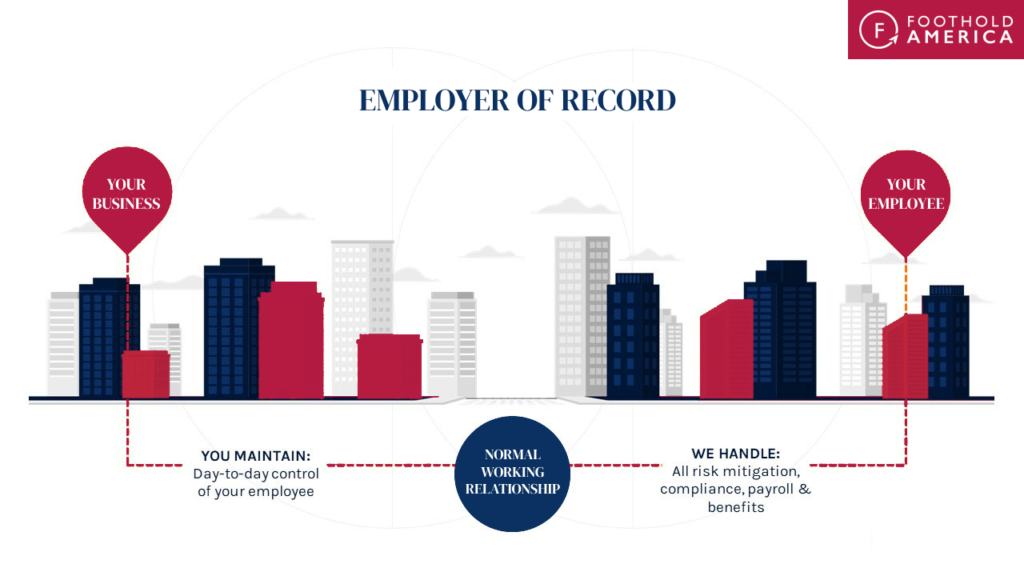
The EOR service fee covers payroll processing, federal and state tax filings, compliance with state and federal employment law, benefits enrolment and administration, contract drafting, onboarding, and ongoing HR support. It does not cover the salary, the payroll taxes themselves, or the benefits premiums. Those are pass-through costs, not the provider’s margin.
For a full walkthrough of what happens after you sign, see our guide on the EOR implementation timeline and process. For companies also evaluating professional employer organisations, see our EOR vs PEO comparison guide.
Component 2: Federal employer payroll taxes (FICA and FUTA)
Every US employer pays federal payroll taxes on top of gross wages. These are not the EOR’s fee. They are statutory taxes paid to the IRS and the Social Security Administration, and they apply regardless of which provider you use.
The two federal employer taxes are:
FICA (Social Security and Medicare). The employer pays 7.65 percent of gross wages for FICA, broken down as 6.2 percent Social Security plus 1.45 percent Medicare. The Social Security portion applies up to the 2026 wage base of $184,500 per employee, up from $176,100 in 2025. The Medicare portion has no wage cap and applies to all earnings. The employer does not match the additional 0.9 percent Medicare surtax on employee wages over $200,000, which is borne entirely by the employee.
FUTA (Federal Unemployment Tax). The standard FUTA rate is 6 percent on the first $7,000 of wages per employee, which most employers receive a 5.4 percent credit on for paying state unemployment taxes on time. The effective FUTA rate in most states is therefore 0.6 percent, or roughly $42 per employee per year. California and the US Virgin Islands currently face a FUTA credit reduction due to outstanding federal unemployment loans, which raises the effective FUTA rate to 1.8 percent in California for the 2025 tax year, with a potential further increase for 2026 if California does not repay its loan balance by November 10, 2026.
Component 3: State unemployment insurance (SUTA)
State unemployment insurance varies dramatically across the country. New employers are typically assigned a default rate for the first two to three years, then move to an experience-based rate.
Approximate 2026 SUTA ranges include New York from 2.025 to 9.825 percent on the first $17,600 of wages, California from 1.5 to 6.2 percent on the first $7,000, Florida from 0.1 to 5.4 percent on the first $7,000, Washington with the highest taxable wage base at $78,200, and New Jersey from 0.5 to 5.8 percent on the first $44,800. In Washington, SUTA alone can exceed $4,000 per employee per year.
For most US hires, the combined federal and state employer payroll tax burden is driven by FICA at 7.65 percent on wages up to the Social Security cap, plus a much smaller FUTA contribution, plus state-specific SUTA that varies materially by state, wage base, and the employer’s experience rating. The worked example later in this guide shows the calculation for one specific scenario.
Component 4: Health insurance and welfare benefits
Health insurance is the single largest non-salary cost of US employment, and it has been climbing for years. According to the KFF 2025 Employer Health Benefits Survey, the average annual premium for employer-sponsored health insurance in 2025 was $9,325 for single coverage and $26,993 for family coverage. Premiums rose 5 percent and 6 percent respectively year over year, and KFF noted early reports of higher cost trends for 2026.
The employer portion is roughly 84 percent of single coverage ($7,885 a year on average) and 75 percent of family coverage ($20,143 a year on average), with the employee paying the rest through payroll deductions. Plans through an EOR typically include medical, dental, vision, and basic life insurance as a bundle.
Other US benefits an EOR will typically administer and pass through include short-term and long-term disability insurance, basic group life insurance (often bundled with medical), 401(k) plan administration with an employer match if offered, and paid time off including state-mandated sick leave and family leave entitlements.
How much benefits add to total employer cost varies significantly. The single biggest driver is whether the employee is on single or family health coverage, which more than doubles the employer’s annual premium based on the KFF 2025 averages. The second biggest driver is the employer 401(k) match, which is a discretionary employer choice rather than a statutory requirement.
Component 5: Workers’ compensation insurance
Every US state except Texas requires workers’ compensation insurance for employers, and Texas employers who opt out face their own tort liability. Workers’ compensation rates are set by state and by job classification. A software engineer working from home will carry a very different rate from a field service technician or a manufacturing role.
For most professional or office-based US hires, workers’ compensation is a relatively small percentage of payroll, well under 1 percent. For higher-risk industrial or field roles, the rate can be many multiples higher. The EOR carries the policy and passes the premium through, with the underlying rates set by state and by NCCI or state-specific job classification. The National Council on Compensation Insurance publishes the relevant rate filings for the states that use NCCI codes.
Component 6: Add-ons, setup fees, and the hidden costs
This is the layer that catches international employers off guard.
Setup and onboarding fees. Many EOR providers charge a one-off setup fee per employee to cover contract drafting, payroll system setup, benefits enrolment, and state registrations. Some absorb this. Others charge several hundred to a few thousand dollars per hire.
Multi-state surcharges. Hiring employees across multiple US states triggers tax registrations in each state. Some providers absorb this. Others charge per-state setup fees and ongoing administration fees that are separate from the headline EOR fee.
Termination and offboarding fees. Some providers charge a separation fee at the end of employment to cover final pay processing, COBRA notices, state separation paperwork, and unemployment claims handling. The amount varies by provider, and a meaningful share of EOR providers do charge this.
Foreign exchange markups. Providers that invoice in your home currency rather than US dollars often apply an FX markup on top of the interbank rate. Over a 12-month engagement on a moderate-to-high salary, this can quietly add several thousand dollars in pure margin to the provider.
Annual minimums and platform fees. Some providers charge an annual minimum, a software platform fee, or a per-payroll-run fee that does not appear on the headline monthly quote.
State-specific compliance add-ons. California, New York, Massachusetts, and a handful of other states have additional employment law obligations (paid sick leave, paid family leave, predictive scheduling, expense reimbursement laws) that can add administrative fees per pay cycle.
Putting it together: a worked example
Take a UK technology company hiring a Senior Software Engineer in New York. The illustrative inputs below assume a $150,000 base salary, family health coverage, a 4 percent 401(k) match, a workers’ compensation rate consistent with office-based software roles, a mid-tier EOR fee, and a mid-range SUTA rate. Actual numbers will vary depending on your provider, the employee’s family status, and the specific state.
Cost component (illustrative) | Annual amount |
Gross salary | $150,000 |
FICA (7.65% on first $184,500) | $11,475 |
FUTA (effective 0.6% on first $7,000) | $42 |
New York SUTA (estimated on first $17,600) | $550 |
Health insurance (employer portion, family coverage, KFF 2025 average) | $20,143 |
Workers’ compensation (estimated for software role) | $750 |
401(k) employer match (4% of salary) | $6,000 |
EOR service fee (mid-tier illustrative example, $799/month) | $9,588 |
Total annual employer cost (illustrative) | $198,548 |
In this example, the total cost is roughly 32 percent above the base salary. Real numbers vary significantly by state, by family status, by 401(k) match level, and by EOR pricing tier. Lower-salary roles tend to have a higher percentage uplift because health insurance and the EOR fee represent a larger share of the total. Higher-salary roles benefit from the Social Security wage base cap on FICA.
EOR vs entity setup: when does the math flip?
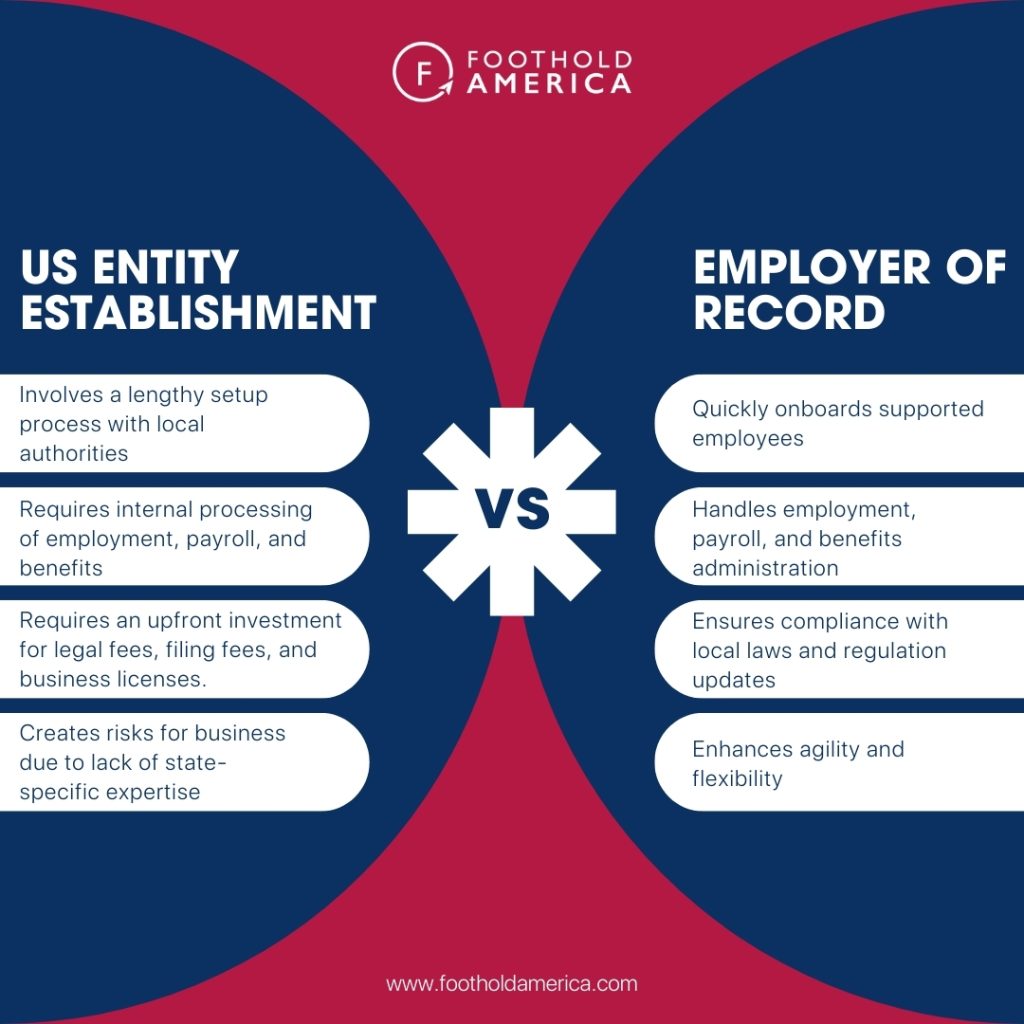
EOR economics work best for international companies with a small US headcount, or for new entrants using an EOR to test the US market before committing to full entity infrastructure. As headcount grows, the per-employee EOR fee starts to outweigh the fixed cost of operating a US entity.
The breakeven point varies significantly based on state mix, benefits structure, average salary level, and the EOR pricing tier in use. In our experience, this transition is something most international companies should reassess once US headcount moves into double digits.
Life science companies have additional considerations. See our guide on EOR vs entity setup for life science companies. For a deeper comparison, see our guide on how to choose between EOR and entity setup for US expansion.
What to look for in an EOR contract
In our experience advising international companies on US EOR engagements, the contractual terms matter as much as the headline price. The questions we encourage clients to ask before signing include:
Is the monthly fee inclusive or à la carte? Some providers quote a low base fee and charge separately for benefits administration, equity administration, expense management, or off-cycle payroll runs.
What is the offboarding fee? This is the single most under-disclosed cost in EOR contracts. Some providers charge nothing. Others charge a meaningful per-termination fee that only becomes visible at separation.
What is the FX policy? A provider that converts at the mid-market rate is materially different from one that adds a percentage on top.
What is the contract length and termination notice? Many providers require multi-month minimum commitments or 30 to 60 days termination notice, which can cost real money if your US hire does not work out.
How is the EOR’s own employer infrastructure structured? Some providers run their own US payroll and benefits infrastructure. Others sub-contract to a US-based partner and add a layer of margin. The difference is rarely visible to the client. If you are unhappy with your current provider, see our guide on changing EOR partners. For a deeper look at contract terms, see our guide on understanding EOR contracts.
What we see most often
“International clients often come to us comparing EOR providers on the headline monthly fee. By the time we have walked them through the full cost stack, the cheapest provider on paper is frequently no longer the cheapest in practice. The savings on the fee get eaten by FX markups, multi-state surcharges, and offboarding fees. The right question is always what the all-in annual cost looks like across the actual scenarios you expect to encounter.” – Angelique Soulet-Bangurah PHR, Head of EOR Services at Foothold America
A pattern we see often
A common pattern we see with international clients comparing EOR providers is significant divergence between the headline monthly fee and the all-in annual cost. Companies that sign with low-cost providers based on the advertised rate often discover, several months in, that their actual monthly cost is materially higher once FX markups, per-state setup fees, benefits administration surcharges, and offboarding fees are layered in.
The headline number is rarely a reliable predictor of the actual invoice. The all-in cost is what matters for budgeting, and the difference between the cheapest-on-paper option and the best-value option in practice is rarely visible at contract signing.
How to budget for a US EOR hire

The total annual employer cost of a US EOR hire depends primarily on five variables: the gross salary, whether the employee will take single or family health coverage, the state of employment, the 401(k) match level (if any), and the EOR pricing tier you choose.
Of those, family versus single health coverage is the largest single swing factor. Based on the KFF 2025 averages, the employer’s share of family coverage is more than twice the employer’s share of single coverage.
State of employment is the next largest variable, driven by SUTA wage bases and rate ranges that vary materially across the country. Salary level matters less than non-specialists tend to assume, because the largest non-salary costs (health insurance and the EOR fee) are largely fixed per employee rather than proportional to wages.
The best way to budget accurately is to take the components in this guide, apply your actual scenario (state, family status, intended benefits, target salary, chosen EOR pricing tier), and add them up. We are happy to help international clients build that calculation for specific roles they are scoping.
–
Editorial process
This article was researched against primary sources current as of 2026, including the Social Security Administration’s 2026 contribution and benefit base, the IRS guidance on Federal Unemployment Tax, the US Department of Labor’s state unemployment law database, the KFF 2025 Employer Health Benefits Survey, and the National Council on Compensation Insurance.
EOR market pricing ranges reflect provider rate sheets published in 2025 and 2026 along with Foothold America’s direct experience advising international clients on US EOR engagements. Patterns described in this article reflect generalized observations across our client base rather than specific client situations.
Legal disclaimer
This article provides general information about Employer of Record pricing in the United States and is not legal, tax, or financial advice. Specific employer obligations and costs depend on state of employment, industry classification, salary level, benefits structure, and other factors. International companies considering US expansion should consult qualified US employment counsel and tax advisors before making hiring decisions.