



For most international companies expanding to the US, the choice between using an Employer of Record (EOR) and setting up a US entity is a question of speed, cost, and operational control. For life science companies, the same choice carries an extra layer of complexity that other sectors do not face.
Clinical trial sponsorship. FDA submissions. SBIR and STTR grant eligibility. R&D tax credits. Big pharma licensing deals. Senior medical, regulatory, and clinical hires who expect equity. Each of these factors can change the answer for a biotech, medical device, or diagnostics company in ways they do not change for a SaaS or services firm. The standard EOR-versus-entity reasoning still applies. It is just no longer enough.
At Foothold America, we work with international biotech founders, medical device CEOs, and diagnostics companies expanding to the US every week. Most arrive thinking they need a full entity from day one. Many do not. Others assume they can stay on an EOR indefinitely.
They cannot.
This guide explains the factors that should drive the choice for life science companies in 2026, the stage-by-stage logic we walk every client through, and the hybrid models that often work best in practice. For the broader geographic picture, our companion guide on where to expand your life science company in the US covers the major hubs in detail.
A quick refresher on the two options
Before getting into life science specifics, a short summary of the two structures.
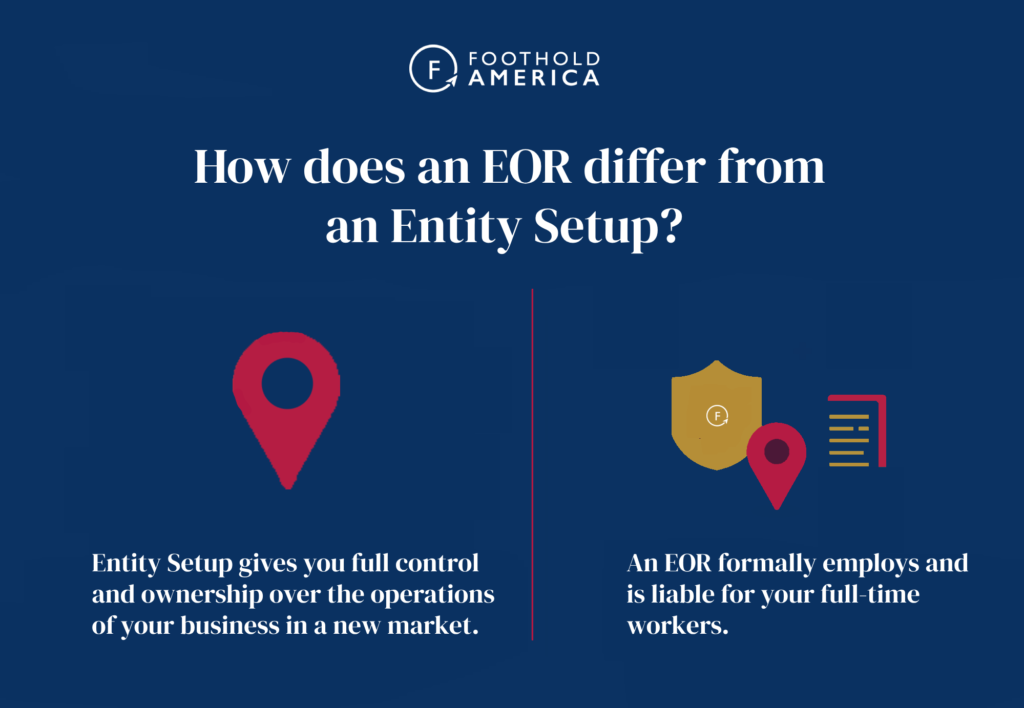
Employer of Record (EOR). A third-party US entity legally employs your American workers on your behalf. The EOR handles payroll, taxes, benefits, state compliance, and employment law. You manage day-to-day work. There is no US entity required on your side. Onboarding typically takes one to two weeks. Costs are a fixed monthly fee per employee, usually a few hundred to a few thousand dollars. Our guide to using an EOR for US market testing covers the structure in detail, and EOR vs PEO vs GEO compares the closest alternatives.
US Entity Setup. You incorporate a US company, usually a Delaware C-corporation, open a US bank account, get an EIN, register as a foreign entity in operating states, and build the payroll, benefits, and HR infrastructure you need to hire directly. Timeline is three to six months. Setup costs typically run $15,000 to $40,000 in the first year before any operating costs. Our US company registration guide covers the full sequence.
For a typical software, services, or consumer brand, the choice between these two often comes down to headcount, urgency, and capital. For life science, several other factors weigh in heavily, sometimes overriding the standard logic.
Why life science is different
The first thing to understand is that life science companies operate in a regulated environment from a much earlier stage than most other sectors. A SaaS company can generate millions in revenue before its corporate structure matters much beyond tax and payroll. A biotech can need a specific legal structure before it has any revenue at all.
The reasons sit in five places: regulatory responsibility, intellectual property, grant access, investor expectations, and senior hiring economics. Each one can independently push the answer toward entity setup even where pure operational logic would suggest an EOR.
The funding environment in 2025 and 2026 makes this calculation tighter. Private biotech financing slowed markedly in the first half of 2025 compared with the same period in 2024, which makes capital efficiency a bigger consideration for early-stage companies. Capital efficiency matters more than ever, which raises the stakes on getting the structural decision right. Spending tens of thousands on entity infrastructure you do not yet need is wasteful. Skipping entity setup when you need it for grants or licensing is even more wasteful.
Factor 1: Clinical trial sponsorship
This is the single biggest factor that pushes life science companies toward entity setup earlier than other sectors would.
A clinical trial conducted in the US under an Investigational New Drug (IND) application must have a sponsor. The FDA defines the sponsor as the legal entity that holds responsibility for the trial. That entity files the IND, holds the regulatory correspondence with FDA, accepts the safety reporting obligations under 21 CFR 312.32, and ultimately owns the data generated by the trial.
An EOR cannot perform any of this on your behalf. The EOR is your employee’s legal employer, not your company’s legal proxy. If your US clinical operations lead, hired through an EOR, signs an FDA submission, that submission belongs to the EOR, not to you. No EOR will accept that liability, and no FDA-experienced clinical operations lead will sign on those terms.
In strict regulatory terms, a foreign parent company can act as the sponsor of a US clinical trial by designating a US agent under 21 CFR 312.23(a)(1)(ix). In practice, almost every international biotech we work with sets up a US entity before US clinical operations begin because the operational logic, banking with US CROs, contracting with US clinical sites, employing the clinical team, and FDA inspection readiness all push in the same direction. We typically advise clients to begin entity setup as soon as they have a clear timeline to IND, even if their first US hire goes through an EOR while infrastructure is built.
Companies running foreign clinical studies whose data they intend to submit to FDA face slightly different rules under 21 CFR 312.120. The sponsor still matters, but the entity structure question depends on whether the data will support a future US application.
Factor 2: FDA submissions and regulatory holdings
Beyond clinical trial sponsorship, every life science company eventually faces the question of who holds regulatory submissions in the United States.
For drugs, this means INDs, NDAs, BLAs, and post-approval filings. For medical devices, it means 510(k) submissions, IDE applications, PMA filings, and Quality System inspections. For diagnostics, it can mean a mix of FDA clearance and CLIA certification depending on the test category.
In every case, the regulatory submission holder is the entity. An EOR cannot hold a 510(k). An EOR cannot be inspected by FDA for GMP compliance on your behalf. An EOR cannot maintain your Drug Master File. The moment regulatory ownership in the US matters, an entity becomes non-negotiable.
This does not mean you need an entity from day one. A pre-clinical biotech doing discovery work can run for a year or more on an EOR-based US team while regulatory submissions remain entirely the responsibility of the parent. The moment regulatory work starts shifting to the US team, the entity needs to exist.
Factor 3: SBIR, STTR, and US grant eligibility
This is one of the most misunderstood factors in life science US expansion, and it surprises a lot of international biotech founders.
Small Business Innovation Research (SBIR) and Small Business Technology Transfer (STTR) grants are administered across multiple federal agencies, including the National Institutes of Health (NIH), the Department of Defense, and the National Science Foundation. NIH SBIR and STTR programs deploy roughly $1.2 to $1.4 billion annually in non-dilutive funding to small businesses, mandated at 3.65 percent of NIH’s extramural research budget. The total SBIR program across all 11 participating agencies exceeds $4 billion per year. For a pre-clinical or early-clinical biotech, this is one of the most attractive sources of capital available. After a brief statutory lapse in September 2025, the program was reauthorized in 2026, with NIH SBIR Phase I awards now up to $323,090 and Phase II awards up to $2,153,927 before waiver topics.
The eligibility rules are strict. To qualify for SBIR or STTR funding, a company must be a for-profit small business located in the United States, with no more than 500 employees. It must also be more than 50 percent owned and controlled by US citizens or permanent residents. NIH has a separate authority that allows it to award up to 25 percent of its SBIR set-aside to small businesses majority-owned by multiple venture capital firms, hedge funds, or private equity, but this is a narrow exception.
The implication for international companies is significant. A US subsidiary that is 100 percent owned by a UK, German, or Swiss parent is generally not eligible for SBIR or STTR funding. The parent’s foreign ownership disqualifies the subsidiary regardless of how the US operation is structured.
This does not change the EOR-versus-entity decision directly, but it does mean that companies expecting SBIR or STTR funding need to think about ownership structure at the same time they think about entity setup. We work with clients on this with US tax and corporate counsel because the structuring options, including independent US founders, US-resident equity holders, or restructuring the parent ownership, all have downstream implications.
For other grants and incentives, including state-level life science grants, US economic development incentives, and certain BARDA or ARPA-H contracts, US entity status is often a prerequisite. An EOR-only structure typically rules these out.
Factor 4: R&D tax credits and US tax structure
US life science companies have access to two distinct federal tax benefits for research and development conducted in the United States, and both require a US entity to claim.
The first is immediate expensing of domestic R&D costs under Section 174A, created by the One Big Beautiful Bill Act signed on July 4, 2025. For tax years beginning after December 31, 2024, US companies can fully expense their domestic research and experimental expenditures in the year they are incurred, rather than capitalising and amortising them over five years as required between 2022 and 2024 under the Tax Cuts and Jobs Act rules.
The second is the federal R&D tax credit under Section 41, which existed before the 2025 legislation and remains in place. The credit applies to qualified research expenses incurred by the US entity and can offset federal income tax liability or, for qualifying small businesses, payroll taxes.
For international life science companies, three points matter most. First, both benefits flow to the US entity. An EOR-employed researcher’s costs sit on the EOR’s books, not yours, which means neither the Section 174A deduction nor the Section 41 credit applies. Second, foreign R&D expenditures remain subject to 15-year capitalisation under the unchanged Section 174 rules, which means moving research to the US carries a meaningful tax advantage versus running it from the home country. Third, state-level R&D credits in California, Massachusetts, New York, and other key biotech states layer on top of the federal credit.
For a biotech with significant US-based research activity, the combined effect of immediate expensing and the credit can amount to hundreds of thousands of dollars per year in tax savings. This is a strong argument for entity setup as soon as material US-based R&D begins, even if commercial operations remain limited.
The Internal Revenue Service maintains detailed guidance on what qualifies as research activity for credit purposes, and the IRS issued Revenue Procedure 2025-28 in August 2025 with transition guidance on the new Section 174A rules.
Factor 5: Investor and fundraising expectations
The US life science venture market has very specific expectations about corporate structure. Most US life science venture capital firms expect to invest in a Delaware C-corporation. Convertible notes from US investors are typically issued by a Delaware C-corp. SAFEs require the same.
For an international biotech planning to raise US capital, the entity question is almost always answered by the fundraising timeline. The fundraise will require a Delaware C-corp before the round closes. EOR is fine for the pre-fundraise period. The moment a US investor signals interest, entity setup becomes urgent.
This is true even where the US round is small. Crossover funds, syndicate leads, and seed-stage life science VCs are typically not flexible on corporate structure. They want the standard Delaware C-corp before they wire funds.
“We often see international founders postpone entity setup to save costs in the first year, then realise mid-fundraise that they cannot close their US Series A without it,” says Laurie Spicer, Director of US Expansion at Foothold America. “Compressing six months of entity work into six weeks during a financing is expensive and stressful. We try to time entity setup to land before the fundraise, not in the middle of it.”
Factor 6: Senior life science hires and equity compensation
Life science companies attract senior US talent through three things: scientific mission, salary, and equity. The third one is where structure matters most.
Senior life science roles in the US, including Chief Medical Officers, VPs of Clinical Operations, Heads of Regulatory Affairs, and BD leaders, typically expect meaningful equity packages on top of base salary and bonus. For early-stage biotech, equity is often the largest component of compensation. The expectation is for options or restricted stock in the operating entity, vesting over four years with a one-year cliff, priced through a 409A valuation.
Through an EOR, equity arrangements are possible but more complex. The employee technically works for the EOR, not for you, which creates legal and tax complications around equity grants in the parent company. Some EOR providers facilitate parent-company equity through specific structures, but the result is rarely as clean as direct grants from a US Delaware C-corp.
Through your own US entity, senior hires receive options in a US entity with predictable tax treatment, standard 83(b) election availability, ISO eligibility for qualifying grants, and a clear path to liquidity at an exit event. This is what US life science talent expects.
The implication for the EOR-versus-entity decision is that the more senior the hires you are planning to make, the stronger the case for early entity setup becomes. An EOR works well for sales reps, BD associates, and early commercial hires. For a CMO or VP of Clinical Operations, the equity question alone often forces the entity question.
Factor 7: Big pharma BD partnerships and licensing deals
Most international biotechs eventually license assets to, partner with, or sell to US pharmaceutical companies. These deals require entity-to-entity contracts. The licensee or acquirer needs to know who they are contracting with, what jurisdiction governs the agreement, and where the US legal exposure sits.
A US entity makes these conversations cleaner. It also positions the US operation as a credible commercial counterparty rather than a payroll arrangement. Big pharma BD teams notice the difference.
For early-stage biotech where partnerships are speculative, this factor is forward-looking. For clinical-stage biotech where partnership discussions are active, it is immediate. We have seen international biotech companies lose negotiating leverage in partnership talks because their US presence felt thin, with no entity, no US bank account, and no US directors. Setting up an entity ahead of those conversations changes the perception.
Stage-by-stage decision framework
Pulling these factors together, here is the framework we use with international life science clients.
Pre-clinical and discovery stage. EOR is usually the right answer. You have a small US team, no clinical trials, no regulatory submissions, and limited US-based R&D. The cost and time of full entity setup are not yet justified. Hire your first US researchers, BD lead, or scientific advisors through an EOR while the parent continues to hold the IP and run discovery.
IND-enabling and early Phase 1. Entity setup becomes a planning priority. You may still hire through an EOR for speed, but the entity needs to exist by the time the IND is filed. Begin entity formation 6 to 9 months before your planned IND date.
Phase 1 and Phase 2. Entity becomes operationally essential. While a foreign parent can technically be the IND sponsor through a US agent designation, the US entity is what almost every international biotech we work with sets up by this stage to hold the IND, run the clinical trials, employ the CMO and Clinical Operations team, and manage FDA correspondence. EOR can still be used for non-clinical roles like commercial or BD hires, but the regulatory backbone needs to be the entity.
Phase 3 and pre-commercial. Full entity infrastructure required. The US entity is staffing up Medical Affairs, Regulatory, Quality, Commercial, Market Access, and Supply Chain. The EOR-versus-entity question is no longer open. The question shifts to operational scale and multi-state compliance.
Commercial launch. US entity with full functional teams. Some companies still use EOR-style services for short-term contractors or pilot programs in new states, but the core organisation is direct employment under the US entity.
For medical device companies, the framework is similar but shifted earlier. The 510(k) or PMA holder must be the entity, and FDA inspections cannot be delegated to an EOR. Entity setup typically tracks the timeline to first 510(k) submission, which can be 12 to 24 months earlier than first product launch.
For diagnostics companies, CLIA certification, lab accreditation, and FDA submission requirements push the entity question forward to the point where lab operations begin in the US.
Common hybrid models that work
Most of our life science clients do not pick one structure for all five years. They use a sequence.
Sequence A: EOR first, entity second. First US hire through EOR within two weeks. Entity setup in parallel over the next three to six months. Transition the EOR-hired employee onto the new entity at year-end. This works well for pre-clinical biotech making early commercial or BD hires.
Sequence B: Entity first, then layer in EOR for specific roles. Entity is set up early because of fundraising or regulatory requirements. Most employees are direct hires. EOR is used selectively for short-term contractors, single-state pilots, or hires that need to start before the entity’s payroll infrastructure is fully ready.
Sequence C: Dual-track for distinct activities. Entity holds the regulatory and clinical functions. EOR handles commercial reps in multiple states without triggering nexus or expanded foreign qualification immediately. This is most common for medical device companies expanding their sales footprint across multiple states.
The right sequence depends on stage, capital, fundraising plans, and the regulatory roadmap. There is no single correct answer.
Two anonymised client scenarios
Pre-clinical UK biotech, EOR-first. A UK oncology biotech approached us early in 2025 wanting to hire a US Business Development lead before their planned Series A. They had no IND in sight for at least 18 months, no US-based research, and no immediate fundraising. We placed the BD lead through our EOR within ten days, then began entity setup six months later as the Series A timeline firmed up. The entity was operational by the time the term sheet arrived. The BD lead transitioned onto the entity within four months of incorporation. Total cost of the EOR phase: well under what entity setup would have cost in the same period.
Clinical-stage German medical device company, entity-first. A German cardiovascular device company had completed CE-marked launches in Europe and was preparing a 510(k) submission for the US market. They needed a VP of Regulatory Affairs and a US Quality lead in place before the submission. Both roles required entity-level employment for regulatory accountability. We ran a parallel entity setup and recruitment process, with the entity operational at month four and both senior hires onboarded by month six. EOR was not appropriate at any stage of this project. The wrong choice early would have cost months of regulatory delay.
How Foothold America helps life science companies make this decision
We work with international biotech, medical device, and diagnostics companies on US expansion from first conversation through scaled operations. Most of our life science clients use a combination of our services across the stages above.
- Employer of Record for fast US hiring during pre-clinical and early commercial stages, before entity setup is justified.
- US entity setup including Delaware C-corp formation, EIN, state qualifications, and bank account support, timed to your IND or fundraising milestone.
- PEO+ Cross-Border Support for companies with their own US entity that need ongoing HR, payroll, and benefits administration without building a full US HR function in-house.
- Virtual office in multiple US states for the credible US business address required by banks, investors, and FDA correspondence.
- Talent acquisition for senior life science hires including CMOs, VPs of Clinical Operations, Regulatory leads, and BD executives.
- Cultural Intelligence Advisory for European leadership teams managing US clinical and commercial teams.
The benefit of working with one provider across these services is that the transitions, EOR to entity, single-state to multi-state, are smoother than assembling the pieces from separate vendors. Our full guide for European biotech founders entering the US covers the full strategic context for biotech market entry.
In summary
For international life science companies, the EOR-versus-entity decision is shaped by factors that do not apply to most other sectors. Clinical trial sponsorship, FDA submissions, SBIR and STTR eligibility, R&D tax credits, US investor expectations, senior hire equity, and BD partnerships all influence the right structure at the right stage.
For pre-clinical biotech making early US hires, an EOR is usually the right starting point. For clinical-stage biotech approaching IND or fundraising, entity setup becomes mandatory. For medical device and diagnostics companies, the regulatory submission timeline drives the entity question earlier than commercial logic alone would suggest.
The companies that get this right plan the structural choice alongside the scientific and clinical roadmap, not as an afterthought. The cost of getting it wrong is months of delay in funding, regulatory submissions, or partnership conversations.
If you are weighing the right structure for your US life science expansion, our team works through this decision with international biotech, medical device, and diagnostics founders every week. Get in touch to discuss your specific stage, roadmap, and constraints.
–
Editorial process
This article was researched against primary federal sources current as of 2026, including FDA regulations on clinical trial sponsorship and Investigational New Drug applications under 21 CFR 312, SBA and SBIR Program eligibility rules and 2026 funding levels, IRS guidance on Section 174A and Section 41 following the One Big Beautiful Bill Act of July 2025, and PitchBook and Crunchbase data on 2025 life science venture funding. Practitioner perspectives reflect direct experience advising international life science clients on US expansion structure.
Sources
- US Food and Drug Administration, Investigational New Drug (IND) Application
- 21 CFR 312, Investigational New Drug Application
- Small Business Innovation Research (SBIR) and STTR Program eligibility
- National Institutes of Health Small Business Programs
- Internal Revenue Service, Credit for Increasing Research Activities
- SelectUSA, Life Sciences Industry
Disclaimer
This article provides general information about US expansion structure for international life science companies and is intended for educational purposes only. It is not legal, tax, regulatory, or financial advice and does not establish a professional services relationship. FDA regulations, IRS rules, and SBA eligibility criteria change frequently and depend on specific facts. Before making any structural decision related to US expansion, clinical trial sponsorship, grant eligibility, or tax planning, consult qualified US legal, tax, regulatory, and accounting advisers. Foothold America provides employment, entity setup, and operational services for international companies expanding to the United States; we do not provide legal, tax, or regulatory advice.