

A lot of international companies expanding into the United States think the hardest part is getting payroll right.
They find a provider that can process paychecks in US dollars, handle federal withholding, and produce W-2s at year end. They assume the employment problem is solved.
It is not. Not even close.
Payroll processing is one component of US employment. It is the part that shows up on a schedule and produces a number. The rest of it, employment law compliance, benefits administration, HR risk management, multi-state regulatory complexity, and the support your US employees actually need, sits entirely outside what a payroll service does. And for international companies building a US team for the first time, that gap is where things go wrong.
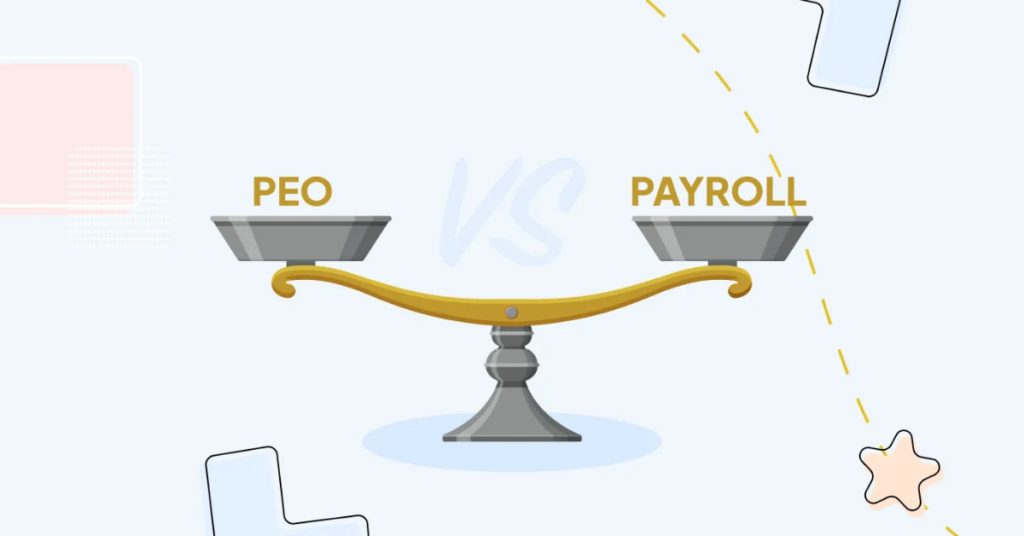
This is the fundamental difference between a payroll provider and a Professional Employer Organization (PEO). One processes transactions. The other becomes your employment infrastructure.
What a Payroll Service Actually Does

A payroll service processes employee compensation. That is its purpose and its scope.
You input the numbers. The payroll service calculates the deductions, runs the payroll cycle, transfers net pay to employees, remits applicable taxes to the IRS and state agencies, and produces pay stubs and year-end tax forms.
Done well, that is valuable. US payroll calculation is complex. Federal income tax withholding involves tables, employee W-4 elections, and calculation rules that are completely different from PAYE. Add Social Security, Medicare, Federal Unemployment Tax Act contributions, and then state-level income tax and unemployment insurance, each with their own rates, wage bases, filing schedules, and payment requirements, and you have a system that requires specialist handling.
But a payroll service assumes you have already solved everything else.
It assumes you have employment contracts that comply with the laws of each state where your employees work. It assumes you have sourced and administered compliant benefits. It assumes you understand your obligations around workers’ compensation insurance. It assumes you know what to do when an employee requests leave under the Family and Medical Leave Act, raises a workplace accommodation concern, or makes a complaint that requires an HR investigation.
A payroll service has no role in any of those situations. It processes what you send it. The compliance framework around it is entirely your responsibility.
For a large US corporation with an established in-house HR team and employment counsel, that is workable. For an international company that is new to the US market and navigating it without that infrastructure, it is a significant and often expensive risk.
What a PEO Does
A Professional Employer Organization operates through a co-employment model. The PEO becomes a co-employer of your US workforce alongside you, which means it takes on a shared layer of employer responsibilities under federal and state law.
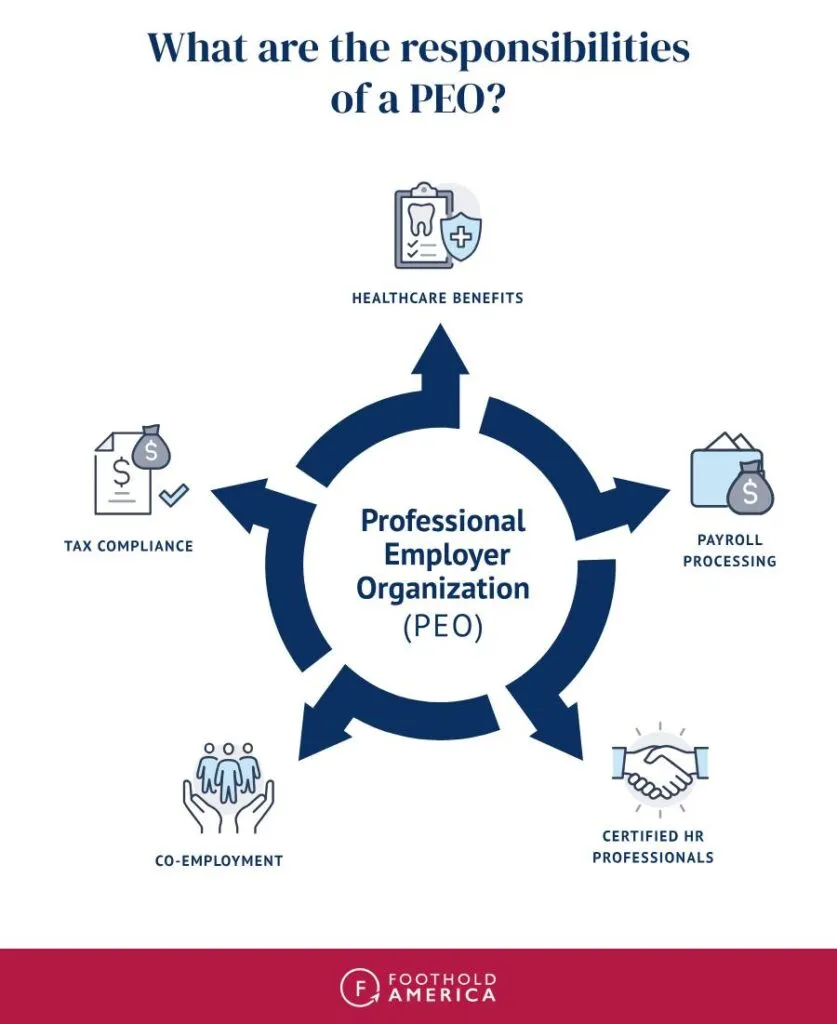
Through that co-employment relationship, the PEO handles:
Payroll and tax administration. The same transaction functions as a payroll service, but within a co-employer compliance structure where the PEO shares employer of record responsibility for accurate tax remittance.
Benefits administration. This is one of the most significant practical differences. A PEO provides access to group health insurance plans, dental and vision coverage, 401(k) retirement plans, life and disability insurance, and other benefits. Because the PEO pools employees across its entire client base, it can offer large-employer benefit economics to small and mid-sized companies. Your US employees get access to competitive health plans you could not source independently with a small headcount.
HR expertise and support. A PEO employs HR professionals who can advise you on employment law questions, performance management, disciplinary procedures, leave management, accommodation requests, and employee relations situations. When something difficult happens with one of your US employees, you have real people to call who can help you handle it correctly. That matters more than you might think until the first time you need it.
Regulatory compliance management. Employment law in the US is not static. Minimum wage rates change. Paid leave laws are expanding across states. Pay transparency requirements are being introduced. Classification rules evolve. A PEO tracks these changes and helps ensure your practices remain compliant as the landscape shifts.
Workers’ compensation. The PEO provides workers’ compensation coverage and manages claims. This is a legal requirement in most US states. A payroll service cannot help you obtain it.
Employee handbook and HR policies. Many PEOs help clients develop US-compliant employee handbooks and HR policies. A handbook is not legally required in most states, but operating without documented policies on harassment, discrimination, leave, and progressive discipline creates real exposure. Without that framework, you are dependent on individual managers handling difficult situations consistently and correctly, without any reference point.
If you are new to the co-employment model, our guide to what a PEO is and how co-employment works in the USA explains the structure clearly.
The data on PEO outcomes is consistent. According to NAPEO, the National Association of Professional Employer Organizations, businesses that use a PEO grow at twice the rate of comparable non-PEO businesses, have employee turnover that is 12% lower, are 50% less likely to go out of business, and see an average return on investment of 27% in cost savings alone. NAPEO’s October 2025 research found that more than 230,000 US businesses now partner with a PEO, representing approximately 15% of all employers with 10 to 499 employees.
Those numbers reflect the practical value of having proper employment infrastructure, competitive benefits, and compliance support, rather than running US employment from a payroll platform and hoping nothing goes wrong.
The Real Cost of Getting This Wrong

International companies that choose payroll-only solutions often discover the gap the hard way. Here are a few scenarios that a payroll service cannot help you navigate.
State-specific leave laws. California, New York, New Jersey, and a growing number of other states have mandatory paid family leave programs funded through employee and employer payroll contributions. If you have an employee in California and your payroll service is not configured correctly for California SDI and PFML contributions, you are non-compliant. The penalties are real and the liability is yours.
Multi-state employment. Many international companies hire US employees in different states simultaneously. A sales hire in Texas, an engineer in Massachusetts, a customer success manager in Illinois. Each state has its own income tax withholding requirements, its own unemployment insurance system, its own paid leave mandates, and its own employment law specifics. A payroll service can handle the payroll mechanics. But who advises you on whether your employment agreement is compliant in each state? Who tells you that Massachusetts has specific restrictions on non-compete clauses that make your standard template unenforceable? A payroll service does not do that.
Employee complaints and HR investigations. US employment law creates a complex environment around discrimination, harassment, and retaliation claims. The Equal Employment Opportunity Commission processes tens of thousands of charges annually. An employee complaint handled incorrectly can escalate rapidly and become expensive very quickly. A PEO has HR professionals trained for exactly these situations. A payroll service has nothing to offer.
Termination. Even in at-will employment states, a termination handled incorrectly creates risk. Final pay requirements vary by state. COBRA notices have strict deadlines. Documentation matters. A PEO guides you through all of this. A payroll service processes the final paycheck and considers its job complete.
Benefits compliance. The Affordable Care Act, ERISA, COBRA, and HIPAA together create a complex compliance environment for employer-sponsored benefits. If you are offering health insurance directly rather than through a PEO’s group plan, you need someone managing compliance across all of these frameworks. A payroll service does not touch benefits.
Why This Gap Hits International Companies Harder
UK and European companies entering the US face a specific version of this problem because so much of what a PEO covers in the US is handled by statute at home.
In the UK, employment rights are encoded in law and apply automatically. Notice periods, sick pay, annual leave entitlement: these exist by default and are relatively uniform. HR disputes go through a defined tribunal process. Payroll runs through PAYE with a centralized structure that most UK employers understand.
None of that translates to the US. Rights that UK employees take for granted often do not exist federally in America. There is no federal minimum paid annual leave entitlement. Sick leave is not federally mandated, though many states are gradually catching up. Employment protections vary dramatically by state.
The result is that an international company can hire a US employee, pay them correctly through a payroll service, and still be significantly non-compliant across several dimensions simultaneously.
Our guide on 5 ways PEO+ saves your US HR team time goes into practical detail on what this looks like in practice. And our piece on transitioning from EOR to PEO explains the path many international companies take as they grow their US teams.
The Cultural Gap That Payroll Cannot Bridge
There is a dimension to US employment that sits entirely outside what a payroll service handles, and that most standard PEO providers do not address either. That dimension is culture.
US employees think about their employment relationship differently from UK or European employees. These differences are not superficial. They affect how you write a job description, how you run a performance review, how you structure compensation, and how you handle a difficult conversation.
At-will employment is the norm but not the full picture. Most US employers and employees understand that employment is at-will. But US employees are also more likely to pursue legal action than UK counterparts when they feel they have been treated unfairly. A wrongful termination claim or a discrimination complaint can arise even from an at-will termination if the process was poorly handled or if a protected characteristic could be argued to have played a role. International employers who interpret at-will as meaning they can simply let someone go without process often learn otherwise at considerable cost.
Benefits are not a perk, they are the offer. In the UK, a job offer centres on salary and pension. In the US, the health insurance plan is often as important as the salary itself. Candidates will ask specifically about plan quality, employer contribution levels, dependent coverage, and out-of-pocket maximums. An employer who cannot answer those questions confidently, or who offers bare-minimum coverage, will lose candidates to better-resourced competitors.
The management culture is different. US employees in professional roles generally expect more frequent and direct feedback than is typical in UK management culture. They expect clarity on performance expectations and transparency about how success is measured and rewarded. The informality that functions well in a UK office can read as a lack of structure to US employees who are used to more defined frameworks.
Holiday and leave are handled very differently. The US has no federal minimum paid annual leave entitlement. Many US employers offer two weeks as a starting point, but this varies by industry and seniority. There is no equivalent of the 28-day statutory minimum under UK law. An international company that applies its UK leave policy to US employees will create confusion and friction.
A PEO that specialises in working with international companies brings this cultural intelligence to the service. At Foothold America, we help you understand not just the legal requirements but the market norms: what US employees expect from their employer, what competitive packages look like, and what management approaches build trust rather than friction. These are things we have learned from years of working at the intersection of UK, European, and American working culture, and they matter as much to your US success as getting the compliance right.
How PEO and Payroll Compare Across Key Functions
Here is a direct comparison of the two models across the employment functions that matter most to international companies building US teams.
Payroll calculation and tax remittance. Both handle this. A PEO does it within a co-employer compliance structure. A payroll service does it as a standalone transaction service with no shared compliance accountability.
Benefits procurement and administration. A PEO provides access to group plans and manages all administration. A payroll service has no role here whatsoever.
Employment contracts and state compliance. A PEO provides US-compliant templates and HR guidance. A payroll service assumes you have this covered independently.
Workers’ compensation. A PEO provides coverage and manages claims. A payroll service does not.
Employee relations and HR support. A PEO employs HR professionals available to advise you. A payroll service has no HR function.
Multi-state regulatory tracking. A PEO monitors regulatory changes across states and applies them to your employment practices. A payroll service handles the payroll mechanics but leaves legal compliance entirely to you.
Onboarding support. Many PEOs provide structured onboarding including new hire paperwork, I-9 verification, background check management, and benefits enrollment. A payroll service begins after all of this is complete.
Year-end compliance. Both produce W-2s. A PEO manages the broader year-end compliance cycle including ACA reporting for applicable large employers.
Benefits: The Most Underestimated Difference
When international companies compare PEO with payroll, they consistently underestimate how significant the benefits dimension is.
US employees do not think of health insurance as optional. It is a core expectation. The quality of the plan, the network of providers it covers, the deductible levels, the out-of-pocket maximums, affects your ability to hire and retain people directly.
A small or medium-sized international company trying to source health insurance independently faces two immediate problems. First, it is expensive: employer contributions to family health coverage run into the tens of thousands of dollars per employee per year. Second, small groups face worse rates and fewer plan options than large employers.
A PEO solves both problems. Because it aggregates employees across dozens or hundreds of client companies, it can access large-group insurance markets and pass better rates to its clients. Your US employees benefit from competitive coverage that you could not achieve independently with a small headcount.
The same applies to 401(k) retirement plans. Experienced US candidates in competitive roles will ask about 401(k) matching during the hiring process. A PEO gives you a compliant, competitive retirement benefit from day one without the overhead of setting up and administering an independent plan under ERISA. Setting one up independently requires selecting a plan administrator, filing a plan document, arranging a fiduciary trustee, and managing ongoing compliance. A PEO handles all of that within its existing structure.
Our piece on the truth about PEO master health plans explains how PEO health plans actually work and what you should be asking about coverage quality before you commit to a provider.
Choosing the Right PEO Partner

If you have decided that a PEO is the right model, the next question is how to choose the right provider. Not all PEOs are built the same, and for international companies the differences are particularly significant.
Most US PEOs serve domestic clients and have limited experience with the specific needs of foreign-owned businesses. They are not equipped to explain how US employment differs from UK or European employment. They cannot advise on cross-border payroll implications. They do not typically field questions about the relationship between co-employment and parent company obligations.
Our guide on 10 things to consider when choosing a PEO partner sets out the evaluation framework clearly. And if you are reviewing an existing PEO relationship that is not working well, our guide on a strategic approach to changing PEO partners covers how to manage that transition without disrupting your employees.
Key things to evaluate when choosing a PEO:
- Experience with international clients. Does the PEO regularly work with foreign-owned businesses? Can they explain US-specific employment issues in a way that makes sense to someone coming from a UK or European background?
- Benefits quality. What health plans do they actually offer? What are the real costs at your headcount? Ask for specific plan details and premium data, not just assurances that the benefits are competitive.
- HR depth. Do they have qualified HR professionals available to you, or are you routed to a call center? When an employment issue arises, who actually picks up the phone?
- Technology and reporting. Can you see your payroll data clearly? Can you access the information you need for internal reporting without digging through multiple systems?
- Dedicated contact. Is there a specific person who knows your account, or are you one of thousands of anonymous clients in a self-serve portal?
Our piece on top tips for finding the best PEO partner goes into the due diligence process in more detail. And Scale Smarter, Not Harder: Benefits of PEOs sets out what you should realistically expect to gain from the relationship.
Making the Right Choice as You Scale
For many international companies, the right answer evolves as the US operation grows.
At the earliest stage, before you have a US entity and when you are making your first hire or two, an Employer of Record is typically the most appropriate tool. It gives you a fully managed employment solution without needing a US legal entity. Our guide on transitioning from EOR to PEO explains when and how to make that progression cleanly.
Once you have established a US entity and are building a team of more than five or six employees, a PEO becomes the right model. It gives you the HR infrastructure, benefits, and compliance support to scale without adding disproportionate internal overhead.
Payroll-only is not a stage in this progression for international companies. It is a tool for mature US employers who have already built the HR infrastructure that international companies are still developing. Choosing it too early leaves you with significant unmanaged exposure.
The NAPEO data makes this case clearly. According to the 2025 Annual Tracking Survey, 80% of businesses using a PEO reported growth in 2025, compared to 67% of businesses that do not. And 83% of PEO users expected growth in 2026, compared to 75% of non-users. These are consistent and meaningful gaps that reflect real operational advantage, not just correlation.
How Foothold America Approaches PEO for International Clients
Foothold America is not a payroll processor. We are not a technology platform. We are a team of real people with deep expertise in US expansion, and that expertise runs through everything we do in the PEO+ model.
When you work with us on PEO+, you get a dedicated advisor who understands both sides of the Atlantic. Someone who can explain why your US employees think about their benefits differently from your UK team. Someone who knows what HR policies you need in place before your first US hire, what the regulatory calendar looks like across your states of operation, and what questions to expect from US candidates in the hiring process.
We pick up the phone. We answer emails the same day. When something difficult happens, whether that is a tricky termination, a leave of absence, or a compliance change, you are not left with a ticket number and a chatbot. You speak to someone who knows your business and who takes ownership of finding the right answer.
We also care about your employees as people. The person you hire in Boston or Austin or Chicago deserves to be set up properly: with the right health plan, the right employment structure, a clear contract, and an employer who understands their obligations. When that is done well, your US employees trust you from day one. When it is done badly, you spend months fixing it. We make sure it is done well.
Our PEO+ Playbook for Foreign-Owned Businesses explains how the model works in full. When you are ready to have a proper conversation about your situation, our team is here.
Talk to our team today and find out what proper US employment infrastructure actually looks like.