


If you assume your US employees will treat the World Cup the way your London or Munich team does, you will be wrong. If you assume they will not care at all, you will be equally wrong.
Both assumptions miss the same thing. American soccer culture is not absent. It is different. The tournament starts tomorrow on US soil, and over the next 39 days, every international employer with US employees will discover what that difference actually looks like in practice.
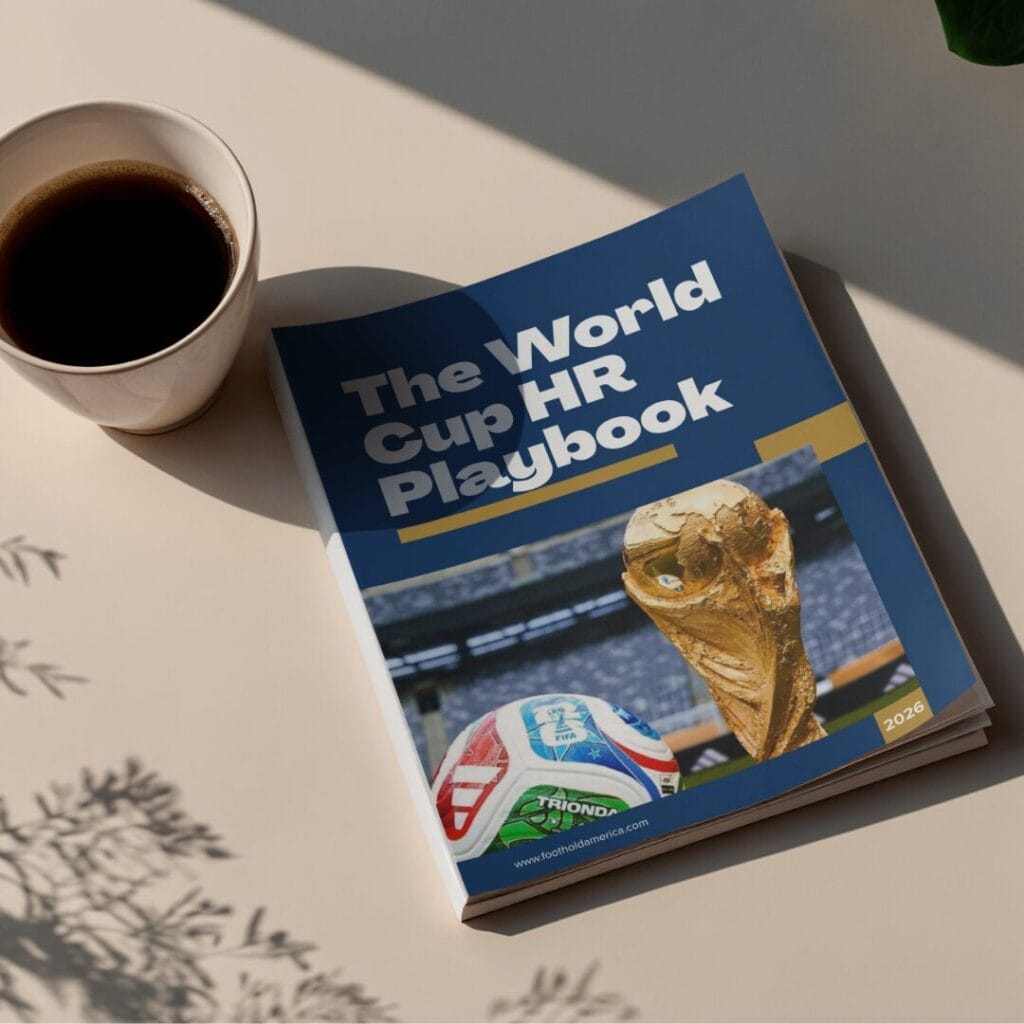
This is Episode 1 of a six-part series for international leaders managing US teams through the 2026 World Cup. We will publish a new episode every Wednesday until 22 July. Today’s episode is the one we wish every European executive read before kickoff.

The size of the audience is bigger than most Europeans think
Around 87 million Americans express at least some interest in the tournament. The 2022 final between Argentina and France drew 25.8 million US viewers across English and Spanish broadcasts, a 31 percent jump from 2018, despite kickoffs at inconvenient hours from Qatar.
For 2026, every USA match is in prime time, in American cities, with home advantage on a stadium your employees can drive to. Fox Sports is broadcasting 70 matches on network television, more than double 2022’s coverage. The audience this tournament reaches will be the largest for any sporting event in US history.
So no, your US team is not indifferent. They are watching.
But the cultural relationship is fundamentally different
Here is where European playbooks fail.
In England, France, Germany, the Netherlands, Spain, the working assumption is that football is a default cultural priority. Offices empty out for big matches. Pub schedules dictate meeting calendars. Employees take half-days without anyone blinking.
That assumption does not transfer. American work culture has three structural realities that change the picture entirely:
Limited paid leave. The typical US employee receives 10 to 15 paid vacation days per year, compared with 25 to 30 across most of Europe. Taking a half-day to watch football is not a casual decision. It costs real PTO from a small allocation, and there is significant cultural guilt around using those days at all.
Match times that overlap with the working day. Many group stage matches kick off between noon and 5pm Eastern Time, smack in the middle of the US workday. The USA’s opening match against Paraguay on 12 June is at 9pm ET (a Friday night, which is kind), but later group games and almost every knockout match land in working hours.
A workforce with multiple home teams. Roughly 14 percent of US workers are foreign-born. In sectors like hospitality, construction, technology, and healthcare, that share is higher. When Mexico plays, Mexican-American employees care. When England plays, British-American employees care. When Colombia, Portugal, Korea, Ghana, or Brazil plays, someone on your team cares deeply. The “home team” is plural.
What this combination produces
The combined effect is not the European pattern of mass simultaneous absence. It is something messier and more interesting.
Some employees will request time off, often for matches you did not anticipate mattering to them. Others will work through their team’s match while quietly checking the score on a phone. Some will want a watch party in the conference room. Some will want to be left alone. A few will want to talk about nothing else for six weeks.
The temptation for European managers is to apply one of two failed templates. The first is “treat it like home” by giving blanket time off for the big matches, which creates resentment from employees whose teams play at different times. The second is “treat it like background noise” by ignoring the tournament entirely, which makes the company look out of touch and disengaged from what is a national moment.
Neither works. The right approach is to engage thoughtfully, plan in advance, and recognise that your US team is going through a cultural event that does not have a clean European parallel.
Three quick mindset shifts before kickoff
If you do nothing else this week, internalise these three things:
One: Your US team is multicultural, and the World Cup makes that visible. This tournament is the most diverse moment of the year inside your US workforce. Employees you have worked with for years may surprise you with their attachment to a national team. That is a gift, not a problem.
Two: Match timing is the real operational challenge, not the tournament itself. A 9pm Friday match changes nothing about your week. A 3pm Tuesday match changes everything. Your policies should be built around match times relative to working hours, not around the abstract idea of “the World Cup.”
Three: How you handle the next 39 days will be remembered. Employees notice how managers respond to moments like this. Get it right and you build trust that lasts long after the trophy is lifted. Get it wrong and you create stories employees tell about your company for years.
What we are publishing in the rest of the series
This Wednesday’s episode is the framing. Over the next five weeks, we go practical:
- 17 June: The detailed playbook on managing US employees through the tournament
- 24 June: A sensible approach to World Cup PTO requests
- 1 July: Running inclusive workplace watch parties
- 8 July: Managing rivalries, banter, and productivity in multinational offices
- 22 July: What worked, what failed, and the broader lessons for international managers
The tournament starts tonight. Most of your competitors will fumble through it. The ones who plan ahead will come out the other side with a stronger US team and a clearer understanding of the culture they are managing in.
That is the goal of this series.
See you next Wednesday.
–
This is the first episode in a six-part series. Read the rest of the World Cup HR Playbook here:
- Episode 2: Why American Workers Treat the World Cup Differently to Europeans
- Episode 3: How to Handle World Cup PTO Requests From Your US Team
- Episode 4: How to Run an Inclusive World Cup Watch Party at Work
- Episode 5: Managing World Cup Rivalries and Banter in a Multinational Office
- Episode 6: What International Managers Learned From the 2026 World Cup